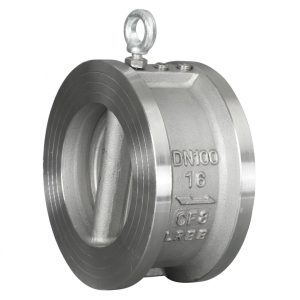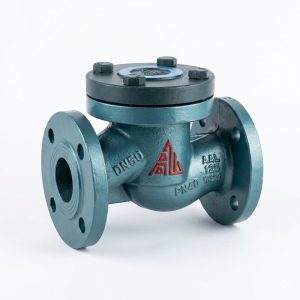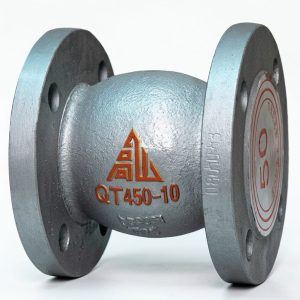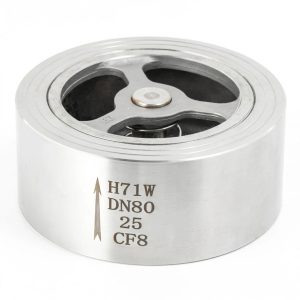
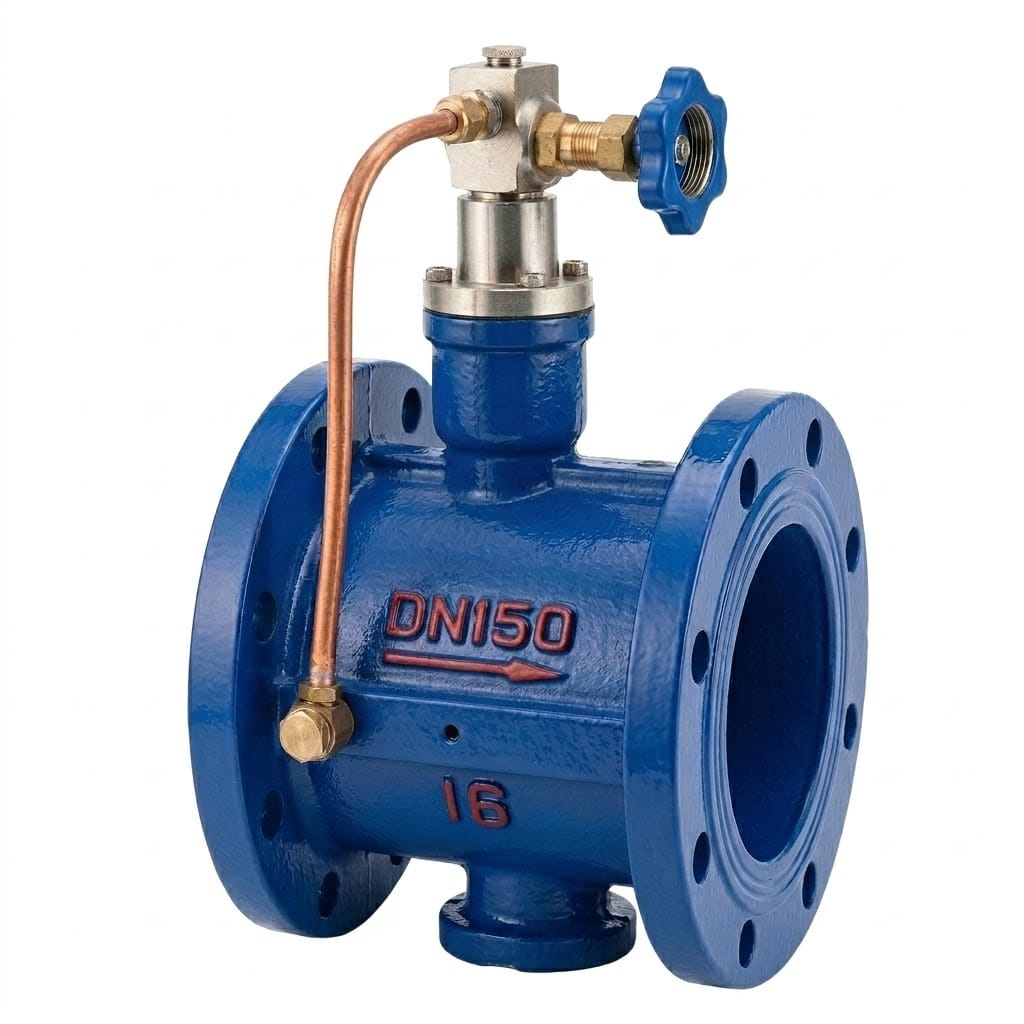
HH46X Butterfly Slow-Closing Check Valve
- Hydraulic slow-close buffer: 1–15 seconds adjustable closing time
- Water hammer peak limited to ≤1.2x nominal pressure
- Butterfly disc design: compact, lightweight, low flow resistance
- Flow-independent rubber seal for bubble-tight shutoff
- PN10 / PN16, DN50–DN600, -10~120°C, flanged connection
Contact Us for Pricing
Interested in this product? Contact us now for detailed pricing and product information.
Product Details
The HH46X butterfly slow-closing check valve is fitted at a pump discharge to protect the pump and pipeline when the pump stops suddenly. A butterfly disc gives a compact, light, low-resistance body, while an integrated hydraulic slow-close cylinder controls how the disc returns: it shuts quickly over most of its travel while reverse flow is still small, then the last part of the stroke is damped by oil pressure over an adjustable 1–15 seconds. Stopping the water column gently rather than all at once caps the pressure spike — here to within 1.2 times nominal pressure. PN10 / PN16, DN50 to DN600, on clean water, sewage, seawater and air.
- Hydraulic slow-close buffer: field-adjustable closing time from 1 to 15 seconds to match the pipeline
- Limits the pump-trip water-hammer peak to no more than 1.2 times nominal pressure
- Two-stage closure – rapid initial shut, oil-damped final seat – so no sudden disc slam
- Butterfly disc body: compact, lightweight and low flow resistance compared with swing or lift checks
- Flow-independent resilient rubber seal (NBR or EPDM) on the disc rim for bubble-tight shutoff
- PN10 / PN16, DN50–DN600, −10 to 120°C, flanged, horizontal or vertical installation
Product Overview
Overseas this valve is sold as a slow-closing / non-slam check valve for pump discharge, where its job is surge and water-hammer control rather than simple non-return.
The HH46X combines a butterfly-style check disc with a built-in hydraulic damping cylinder so that closure is controlled rather than left to gravity and backflow. On a pump discharge line the danger is the moment the pump stops: the forward column of water has momentum, and an ordinary check valve that slams shut against it turns that momentum into a pressure wave that can burst pipe, wreck joints and fatigue the pump. The HH46X closes in two stages: the disc moves fast over most of its travel while reverse velocity is still low, then the final approach to the seat is metered by the oil cylinder over an adjustable 1–15 seconds, decelerating the water column gently. That staged action is what holds the pressure peak to within 1.2 times the nominal pressure.
It is the right valve where the requirement is surge control on a pump station or a long rising main carrying clean or mildly dirty water to 120°C. It is not a metal-seated valve for high temperature or steam — the soft rubber seat limits it, and for hot duty an H41H lift check valve is correct. It also has to be commissioned: the damping orifice is a setting, not a fixed feature, so the closing time must be tuned to the line during the shutdown transient.
What the Model Code Means
Read as a GB/T (JB/T 308) designation for a slow-closing check valve: H = check valve; the doubled H with the pattern marks the slow-closing (hydraulic damped) variant; 4 = flanged connection; 6 = the butterfly / disc structure; X = resilient rubber seat facing; and -10 / -16 give the PN10 and PN16 classes. Control-pattern check-valve coding varies by maker, so send the model on your nameplate and we will confirm it, or read the pattern in the Valve Model Decoder.
Core Strengths
Compact Butterfly Structure
Adopts a unique butterfly-style disc-and-body layout that delivers a remarkably small envelope and low weight compared to conventional swing or lift check valves. Ideal for installations where space and piping support are limited.
Flow-Independent Sealing Surface
The resilient rubber sealing ring is mounted on the disc periphery and presses against the body seat independently of flow dynamics. This ensures bubble-tight shutoff, excellent wear resistance, and an extended service life even under turbulent or particulate-laden conditions.
Hydraulic Slow-Close Buffering
Integrated oil-pressure damping cylinder provides smooth valve opening and a user-adjustable slow-closing cycle from 1 to 15 seconds. Prevents sudden disc slam that causes destructive pressure spikes and pipeline vibration.
High Capacity Low Flow Resistance
The streamlined butterfly disc profile creates a straight-through flow passage with minimal turbulence and pressure drop when fully open. Delivers high volumetric throughput with significant energy savings for continuous-duty pump systems.
Effective Water Hammer Prevention
Engineered to limit water hammer peak pressure to no more than 1.2 times nominal pressure during pump shutdown. Protects downstream pumps, pipelines, joints, and instrumentation from fatigue damage caused by rapid reverse flow.
Wide DN Range up to DN600
Covers the full DN50 through DN600 spectrum at both PN10 and PN16 ratings, making it a single-source solution for municipal water supply networks, sewage lift stations, seawater intake systems, and large industrial circulating water lines.
Performance Specifications
| Parameter | HH46X-10 | HH46X-16 |
|---|---|---|
| Nominal Pressure | PN10 (1.0 MPa) | PN16 (1.6 MPa) |
| Shell Test Pressure | 1.5 MPa | 2.4 MPa |
| Seal Test Pressure | 1.1 MPa | 1.8 MPa |
| Slow-Close Time | 1–15 seconds (adjustable range) | 1–15 seconds (adjustable range) |
| Water Hammer Value | ≤1.2 x nominal pressure | ≤1.2 x nominal pressure |
| Working Temperature | -10°C ~ 120°C | -10°C ~ 120°C |
| Sealing Type | Rubber Soft Seal (Resilient Seated) | Rubber Soft Seal (Resilient Seated) |
| Suitable Media | Water, Sea Water, Sewage, Air, Non-Corrosive Fluids | Water, Sea Water, Sewage, Air, Non-Corrosive Fluids |
| Connection Type | Flanged (GB/T 9113, JB/T 79) | Flanged (GB/T 9113, JB/T 79) |
| Installation Orientation | Horizontal & Vertical | Horizontal & Vertical |
| DN Range | DN50–DN600 | DN50–DN600 |
Shell and seal test pressures are per class (PN10: 1.5 / 1.1 MPa, PN16: 2.4 / 1.8 MPa). The slow-close time (1–15 s), the ≤1.2 x nominal water-hammer limit, the soft-seal duty, the DN50–DN600 range and the −10 to 120°C band are common to both classes.
Materials of Main Parts
| No. | Part Name | Material |
|---|---|---|
| 1 | Body | HT200 Gray Cast Iron |
| 2 | Disc | QT450-10 Ductile Iron |
| 3 | Disc Shaft | 2Cr13 Stainless Steel |
| 4 | Sealing Ring | Rubber (NBR / EPDM) |
| 5 | Spring | 1Cr18Ni9Ti Stainless Steel |
An HT200 gray cast iron body with a QT450-10 ductile iron disc and a 2Cr13 stainless disc shaft; the seal is a resilient rubber ring (NBR or EPDM to your specification) and the return spring is 1Cr18Ni9Ti stainless. Confirm the rubber compound against the medium — EPDM for hot water and many chemicals, NBR as the general grade.
Main Dimensions & Weights (PN10 / PN16)
| DN (mm) | L (mm) | H (mm) | H1 (mm) | Weight (kg) |
|---|---|---|---|---|
| 50 | 190 | 110 | 286 | 25 |
| 65 | 200 | 125 | 306 | 30 |
| 80 | 210 | 150 | 378 | 47 |
| 100 | 230 | 168 | 420 | 65 |
| 125 | 250 | 205 | 430 | 79 |
| 150 | 270 | 230 | 460 | 108 |
| 200 | 290 | 270 | 510 | 154 |
| 250 | 310 | 300 | 530 | 195 |
| 300 | 330 | 320 | 570 | 237 |
| 350 | 350 | 350 | 597 | 322 |
| 400 | 390 | 420 | 700 | 438 |
| 450 | 430 | 460 | 750 | 508 |
| 500 | 470 | 535 | 785 | 682 |
| 600 | 510 | 610 | 890 | 890 |
L = face-to-face length, H = body centre height, H1 = overall height including the slow-close cylinder, all in millimetres; weights in kilograms. Values apply to both the PN10 and PN16 classes and may vary slightly by manufacturing batch; certified drawings are issued with the quotation.
Water-Hammer Control: Which Valve Protects the Pump
| Requirement on pump trip | HH46X slow-closing (this page) | H42F silent check valve | H44H ordinary swing | Water-hammer / surge arrestor |
|---|---|---|---|---|
| Peak pressure control | Two-stage damping caps it to ≤1.2 x nominal | Spring returns the disc before reverse flow builds; low slam but not metered | Disc falls on gravity; can slam and generate a high peak on a large fast-tripping pump | Absorbs the wave rather than controlling the valve; does not stop backflow alone |
| Adjustability | Closing time field-set 1-15 s to the line transient | Fixed spring rate | Fixed gravity behaviour | Vessel sized to the system |
| Also stops reverse flow | Yes | Yes | Yes | No – pair it with a check valve |
| Bore / class | DN50-DN600, PN10 / PN16 | Small-medium bore, spring seat | DN50-DN600 up to PN100 | Any; a tank, not a valve |
| Best used when | Pump station or long rising main where the shutdown spike must be capped | Vertical pump discharge, compact, quiet closure wanted | Large horizontal main, minimum head loss, surge not a concern | Second line of defence where surge exceeds the valve |
Reach for this page when the specification reads “limit the pressure rise on pump failure”. The silent and swing valves manage backflow; only the HH46X meters the closing rate, trading a little closing time for a capped peak. On a severe system an arrestor is fitted in addition, not instead.
Structure Drawing
Design & Manufacturing Standards
- Design Standard: GB/T 12236
- Face-to-Face Dimensions: GB/T 12221
- Flange Standards: GB/T 9113, JB/T 79, HG/T 20592
- Testing & Inspection: GB/T 13927, JB/T 9092
- Rubber Seal Material: NBR (Nitrile) or EPDM per customer specification
- Applicable International Standards: API 594, ISO 5752 (optional)
Installation & Maintenance Guidelines
- Pump Outlet Positioning: Install the valve at the pump discharge outlet to protect the pump and downstream pipeline from reverse flow and water hammer when the pump stops. Ensure the valve is supported independently and does not bear pipeline weight.
- Flow Direction: The valve body is cast with a flow direction arrow. Install the valve so that forward flow follows the arrow direction. Reverse installation will prevent the disc from opening correctly and may damage the hydraulic damping mechanism.
- Horizontal and Vertical Installation: Both orientations are supported. For vertical installation, ensure flow is upward so that gravity assists disc closure and the slow-close cylinder operates correctly.
- Slow-Close Time Adjustment: The hydraulic cylinder damping orifice can be adjusted to set the slow-closing time between 1 and 15 seconds. Start with a mid-range setting (approximately 8 seconds) and fine-tune based on observed pipeline pressure transient measurements during pump shutdown.
- Flange Bolting: Tighten flange bolts in a diagonal star pattern to ensure even gasket compression. Do not over-torque, as distortion of the gray cast iron body may bind the disc shaft and prevent free swinging.
- Rubber Seal Inspection: Periodically inspect the rubber sealing ring for swelling, cracking, abrasion, or permanent deformation. Replace the seal if leakage is observed during the seal test. Ensure replacement seals match the original Shore hardness and rubber compound.
- Hydraulic Cylinder Maintenance: Check the slow-close cylinder oil level and seal condition during scheduled maintenance. Low oil level or leaking seals will reduce damping effectiveness and allow faster disc closure, increasing water hammer risk.
Application Fields
The HH46X is a pump-discharge surge protector, so it is specified where the shutdown transient is the design problem: Municipal Water Supply Pump Stations; Sewage Treatment Plants; Seawater Intake Systems; Industrial Circulating Water; Pressurized Pipeline Networks; Irrigation & Drainage Pumping; HVAC Chilled Water Circuits; Fire Protection Water Supply; Cooling Tower Distribution; Desalination Plants. On clean or mildly dirty water and air in pressurised supply and drainage it is often the one valve that satisfies both the non-return requirement and the hammer limit.
What We Need to Quote Your HH46X Valves
- Size and quantity: DN50–DN600, PN10 or PN16.
- Pump and line data: motor size, static head, pipe length and the shut-off flow, so the slow-close time can be matched to the expected transient.
- Medium: clean water, sewage, seawater or air – this decides the NBR or EPDM seal compound.
- Temperature: the range is −10 to 120°C; confirm anything outside it.
- Orientation: horizontal, or vertical with upward flow.
- Flange standard: GB/T 9113, JB/T 79 or HG/T 20592; RF facing as standard.
- Documentation: material certificates and pressure-test records for the pump station package.
Send the pump curve and pipeline layout and we will recommend the class and a starting slow-close setting. Drawings are in the download center; qualifications on the certifications page.
Frequently Asked Questions
How does a slow-closing check valve actually stop water hammer?
In two stages. When the pump trips, the disc closes quickly over most of its travel while the reverse flow is still small, then the final part of the stroke is metered by a hydraulic oil cylinder over 1 to 15 seconds. Decelerating the last of the water column slowly instead of stopping it dead is what limits the pressure spike – on this valve to within 1.2 times nominal pressure.
What closing time should I set?
It depends on your line, not on a catalogue number. The damping orifice is adjustable from 1 to 15 seconds; start around the middle of the range (about 8 seconds) and fine-tune against measured pressure transients during a simulated pump shutdown. A long, high-velocity rising main generally needs a slower setting than a short discharge header.
Is this the same as a silent check valve?
No. A spring-loaded silent check such as the H42F closes early and quietly, which suits vertical pump discharges and small bores. The HH46X is a butterfly disc with a hydraulic cylinder that you can meter the close on, which is what you need to cap the surge on a large main. Silent valves control the noise; slow-closing valves control the pressure transient.
Can it be installed on a vertical pipe?
Yes, horizontal or vertical, with upward flow on the vertical run so gravity helps the disc return and the cylinder works in its intended orientation. The body carries a flow arrow; reverse installation stops the disc opening correctly and can damage the hydraulic damping mechanism.
Which rubber seal – NBR or EPDM?
NBR is the general water and oil-resistant grade. EPDM suits hot water and a wider range of chemicals but must not be used with petroleum oils. On potable, sewage and seawater duty either is common; give us the medium and temperature and we will confirm the compound.
What maintenance does the hydraulic cylinder need?
Check the cylinder oil level and its seals at scheduled outages. Low oil or a leaking seal lets the disc close faster than set, which raises the water-hammer risk again, and inspect the rubber sealing ring for swelling, cracking or abrasion, replacing it if the valve passes on the seat test. Match any replacement seal to the original Shore hardness and compound.
Gaoshan Valve has manufactured industrial valves since 1975 and holds ISO 9001/14001/45001 with CE, API 6D and PED product certification. It is an approved supplier to Sinopec, CNPC and State Grid and exports to more than 30 countries, supplying water utilities, power plants and EPC contractors.
Get a Quote & Technical Support
Contact Gaoshan Valve for dimension sheets, CAD drawings, slow-close time guidance and a surge assessment before you order. Reply within 24 hours from our overseas sales desk.