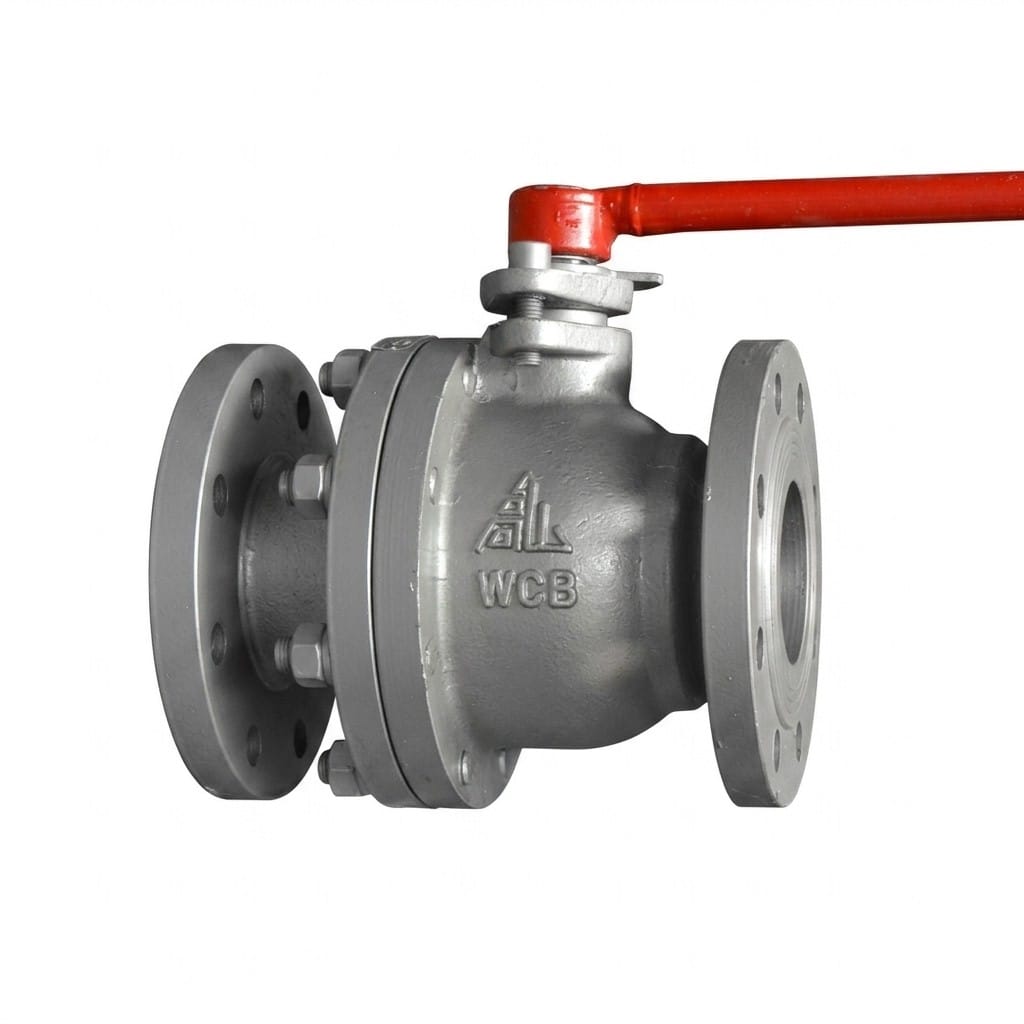
Q41F Ball Valve
The Q41F is a quarter-turn, floating-ball on-off valve with PTFE soft seat rings for bubble-tight shut-off at low operating torque. Available in ductile iron, WCB cast steel, and CF8 stainless steel bodies, it suits water, steam, oil, petroleum, and non-corrosive process lines up to 200°C. The anti-blowout stem with dual PTFE packing prevents stem ejection and external leakage, while lever, bevel gear, or actuated operation options provide flexibility. Sizes range from DN20 to DN200 across PN16 to PN63.
Contact Us for Pricing
Interested in this product? Contact us now for detailed pricing and product information.
Product Details
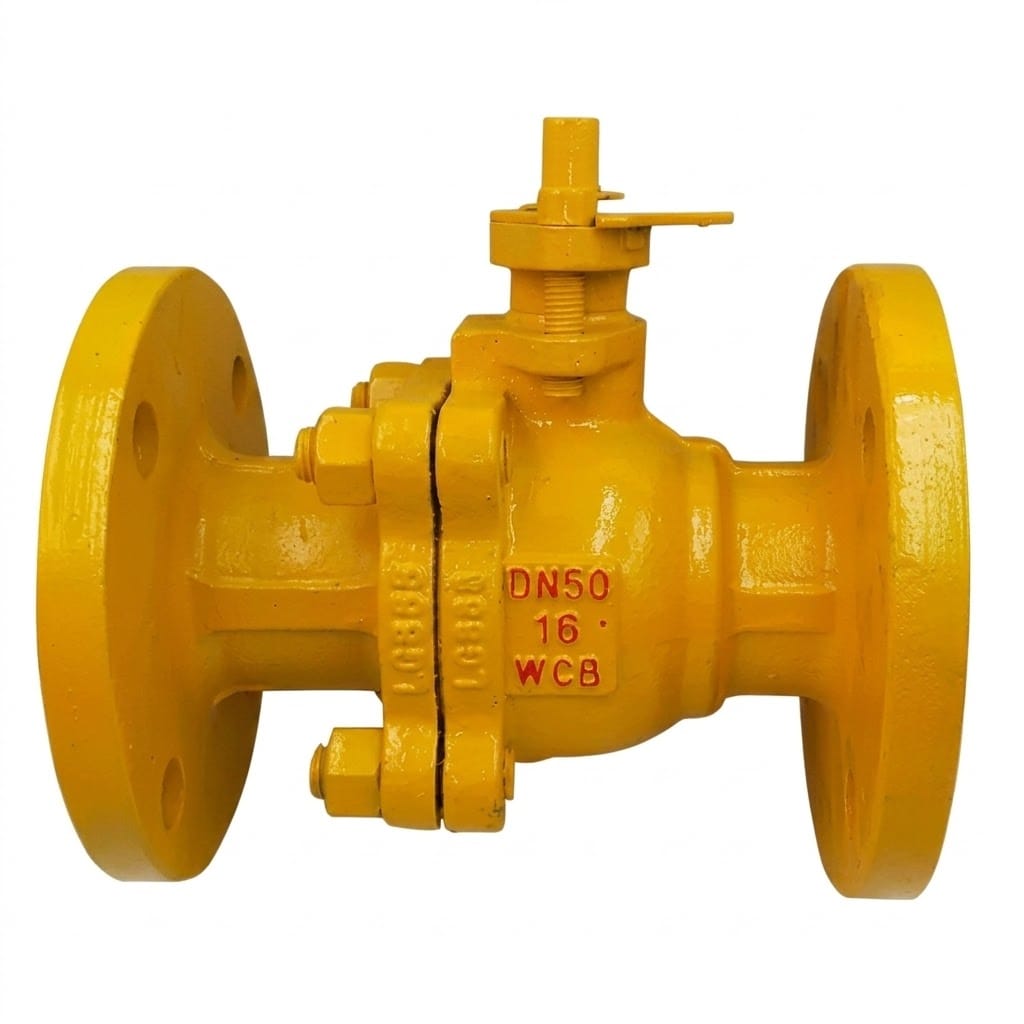
The Q41F flanged ball valve is a quarter-turn, floating-ball on-off valve with PTFE soft seat rings, supplied in ductile iron, WCB cast steel and CF8 stainless bodies across PN16 to PN63 and DN20 to DN200. It gives bubble-tight shut-off at low operating torque, so one operator can isolate a header in a quarter turn — the workhorse isolating valve for water, steam, oil, petroleum and non-corrosive process lines up to 200°C.
- Floating ball with PTFE soft seat rings — bubble-tight shut-off
- Four pressure classes: PN16, PN25, PN40 and PN63, in lever, bevel gear or actuated operation
- Body options: QT450-10 ductile iron (16Q/25Q), ASTM A216 WCB cast steel (16C/25/40), CF8/304 stainless (16P)
- Anti-blowout stem with dual PTFE packing stops stem ejection and external leakage
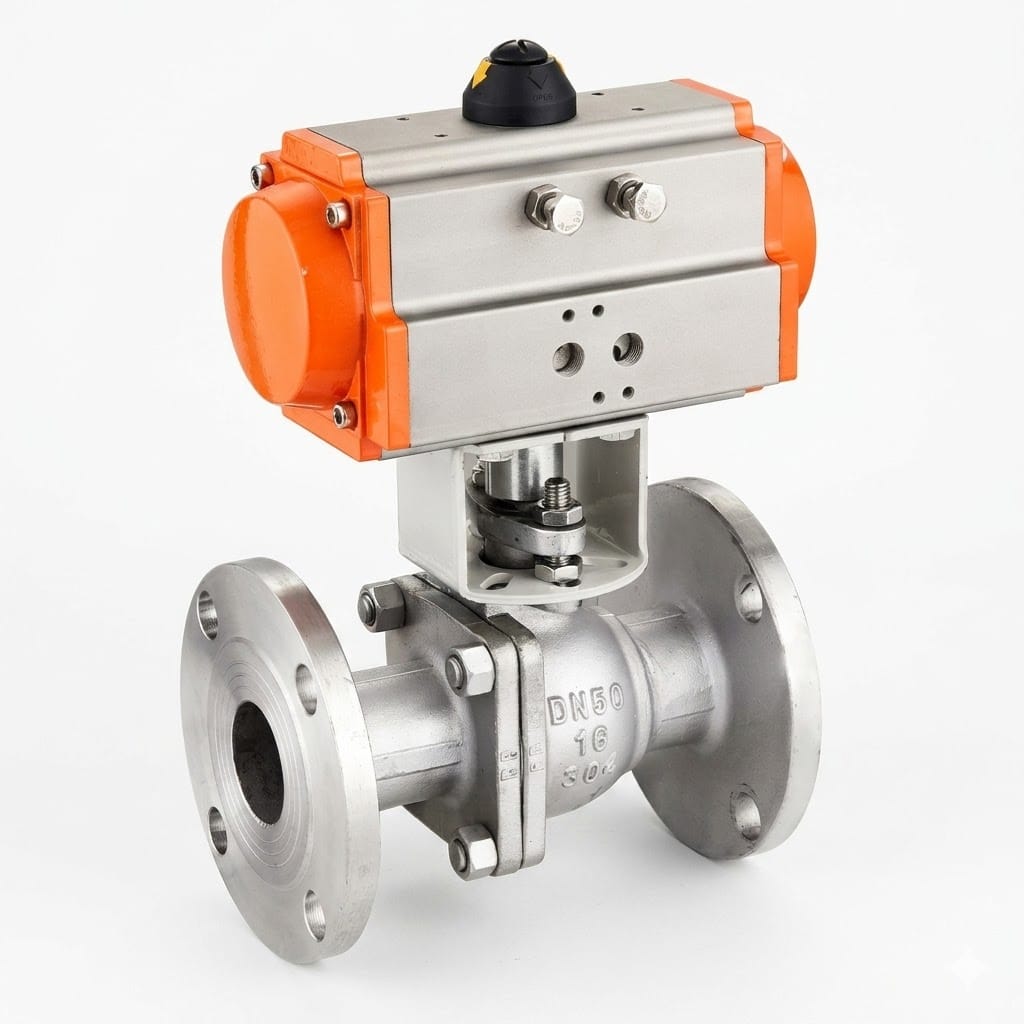
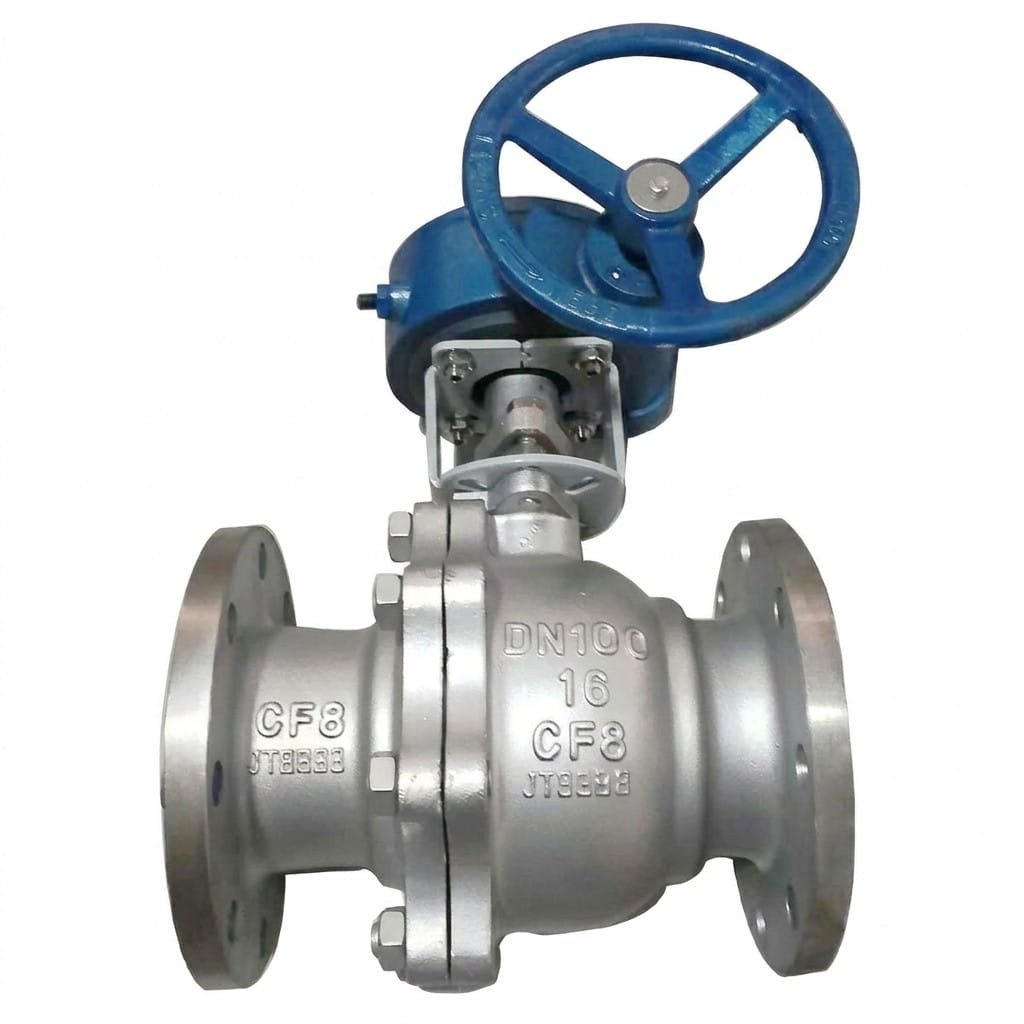
- Quarter-turn operation, low torque; bevel gear on DN125 and above, or pneumatic / electric actuation to order
- DN20–DN200, ≤200°C, suitable for water, steam, oil, petroleum and non-corrosive fluids
Product Overview
The Q41F flanged ball valve series covers six model variants in one body design, which is why it is the most specified isolating valve in our ball valve range. A precision-ground ball sits on two PTFE seat rings and rotates 90 degrees between fully open and fully closed. In the open position the bore aligns with the pipe, so pressure loss is minimal; in the closed position line pressure pushes the ball against the downstream seat, which is what makes the seal self-energising and reliable even after long periods without cycling.
Because the body is offered in ductile iron, cast steel and stainless, the same installation can be quoted at three cost levels: QT450-10 for water and oil duty, WCB where steam and higher pressure classes apply, and CF8 for mildly corrosive service. Every valve is shell and seat tested before packing per GB/T 13927 and API 598.
What the Model Code Means
Q41F follows the GB/T 12237 coding system: Q = ball valve, 4 = flanged connection, 1 = straight-through bore, F = PTFE (fluoropolymer) seat. The suffix carries the class and body material — 16Q = PN16 ductile iron, 16C = PN16 WCB cast steel, 16P = PN16 CF8 stainless. Our Valve Model Decoder breaks down every letter if you are comparing our coding with another supplier’s.
Core Strengths
PTFE Soft Seating System
The machined PTFE seat ring seals tightly against the ball across a wide pH range, with a low friction coefficient for smooth quarter-turn operation and reliable shut-off up to the rated pressure at 200°C. Seats are supplied as a matched upstream/downstream pair so they are always replaced together.
Multi-Material Body Options
QT450-10 ductile iron covers general water and oil duty at the best price. ASTM A216 WCB cast steel takes the higher pressure classes and steam service. CF8 (304) is specified where mild corrosion or product purity matters. Same pattern, same face-to-face, so spares stay interchangeable.
Anti-Blowout Stem Design
The stem is retained by a shoulder and anti-blowout ring, so internal line pressure cannot eject it even if the packing is disturbed. Dual PTFE packing rings with a gland adjuster keep fugitive emission low and allow field re-tightening without dismantling the valve.
Low Operating Torque
Lever operation is one hand movement for sizes up to DN100. Above DN125 the valves are offered with a bevel gear head, and the stem can be extended for insulated or buried pits. Send the duty pressure and medium and we will confirm the torque figure and the correct operator.
Fire-Safe and Inspection Friendly
The side-entry bolted bonnet opens without removing the valve from the line, so seat and ball condition can be checked in a maintenance window. Emergency stem packing and fire-safe design are available on request for hydrocarbon service.
Certified Test Records
Shell test at 1.5x and seat test at 1.1x the rated pressure on every unit, with records retained. EN 10204 3.1 material certificates, CE and API 6D documentation are supplied with tender packages.
Performance Specifications
| Parameter | Q41F-16Q / 16C | Q41F-25Q / 25 | Q41F-40 |
|---|---|---|---|
| Nominal Pressure (PN) | 16 (1.6 MPa) | 25 (2.5 MPa) | 40 (4.0 MPa) |
| Shell Test Pressure | 2.4 MPa | 3.8 MPa | 6.0 MPa |
| Seal Test Pressure | 1.8 MPa | 2.8 MPa | 4.4 MPa |
Values above are for the DN20–DN200 range. PN63 test pressures and the DN125–DN200 PN63 dimensions are issued on the certified datasheet — request them with your enquiry so the numbers match your inspection record rather than a catalogue average.
Operating limits: ball valves are on-off devices. They are not throttling valves — holding the ball part-open subjects the exposed seat to high-velocity flow and erodes it quickly. If your duty needs modulation, look at our globe valves or butterfly valves instead.
Materials of Main Parts
| Model Series | Body & Bonnet | Ball | Stem | Seat Ring / Packing |
|---|---|---|---|---|
| Q41F-16Q / Q41F-25Q | Ductile Cast Iron (QT450-10) | 2Cr13 Martensitic Steel | 2Cr13 / Stainless Steel | PTFE (Polytetrafluoroethylene) |
| Q41F-16C / Q41F-25 / Q41F-40 | WCB Cast Steel (ASTM A216) | Seat Ring / Packing | ||
| Q41F-16P | Stainless Steel (CF8 / 304) | 304 Stainless | 304 Stainless | Seat Ring / Packing |
Model Selection Guide
| Model | Body & Bonnet | Ball / Stem | Class | Typical Service |
|---|---|---|---|---|
| Q41F-16Q | QT450-10 ductile iron | 2Cr13 / 2Cr13 | PN16 | Water, oil, compressed air, HVAC |
| Q41F-25Q | QT450-10 ductile iron | 2Cr13 / 2Cr13 | PN25 | Higher-pressure water and oil duty |
| Q41F-16C | ASTM A216 WCB cast steel | 2Cr13 / stainless | PN16 | Steam, petroleum, plant lines |
| Q41F-25 | ASTM A216 WCB cast steel | 2Cr13 / stainless | PN25 | Steam and process headers |
| Q41F-40 | ASTM A216 WCB cast steel | 2Cr13 / stainless | PN40 | Boiler feed, high-pressure oil |
| Q41F-16P | CF8 / 304 stainless | 304 / 304 | PN16 | Mildly corrosive media, food and chemical lines |
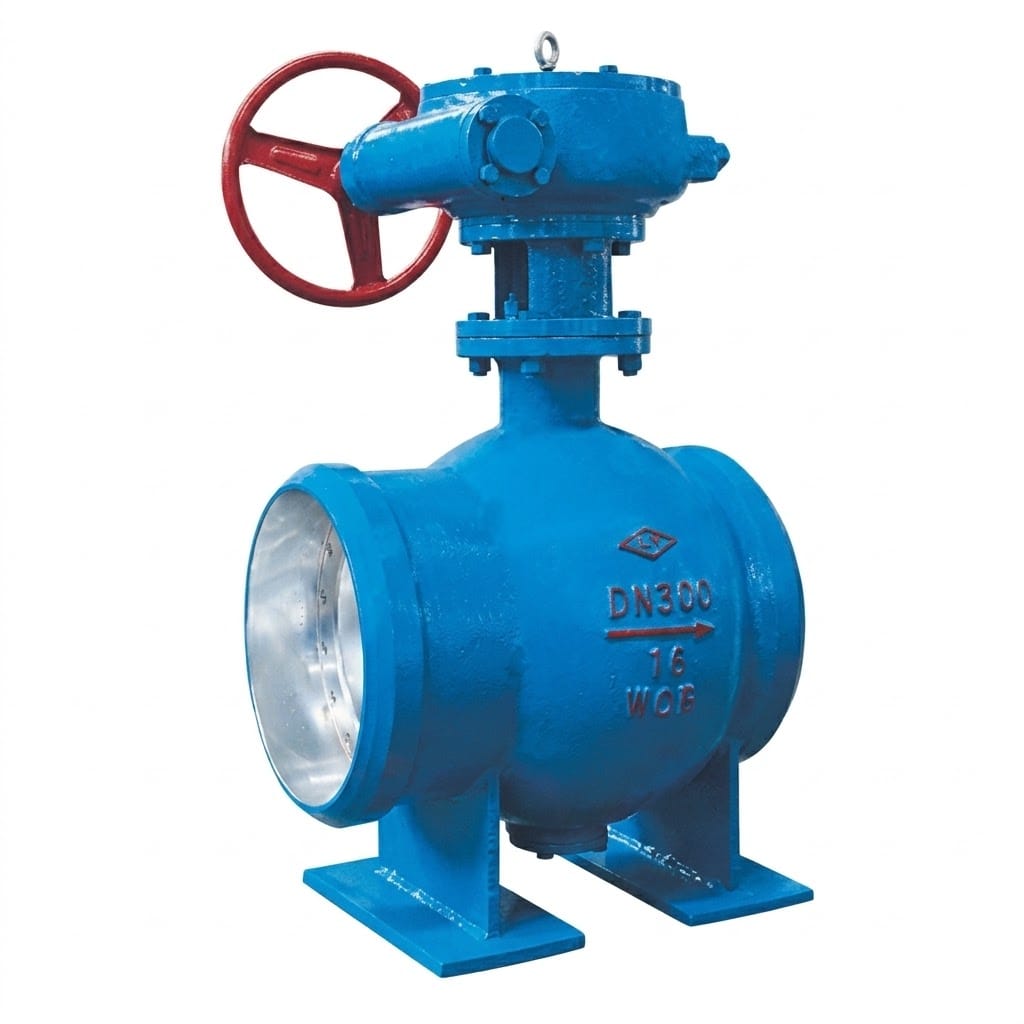
For gas distribution use the RQ41F gas ball valve; for boiler blowdown and blow-off service use the PQ41F blowdown ball valve; for buried district-heating mains use the welded ball valve. They share the Q41F sealing principle but differ in materials, connections and safety features.
Main Dimensions & Weights
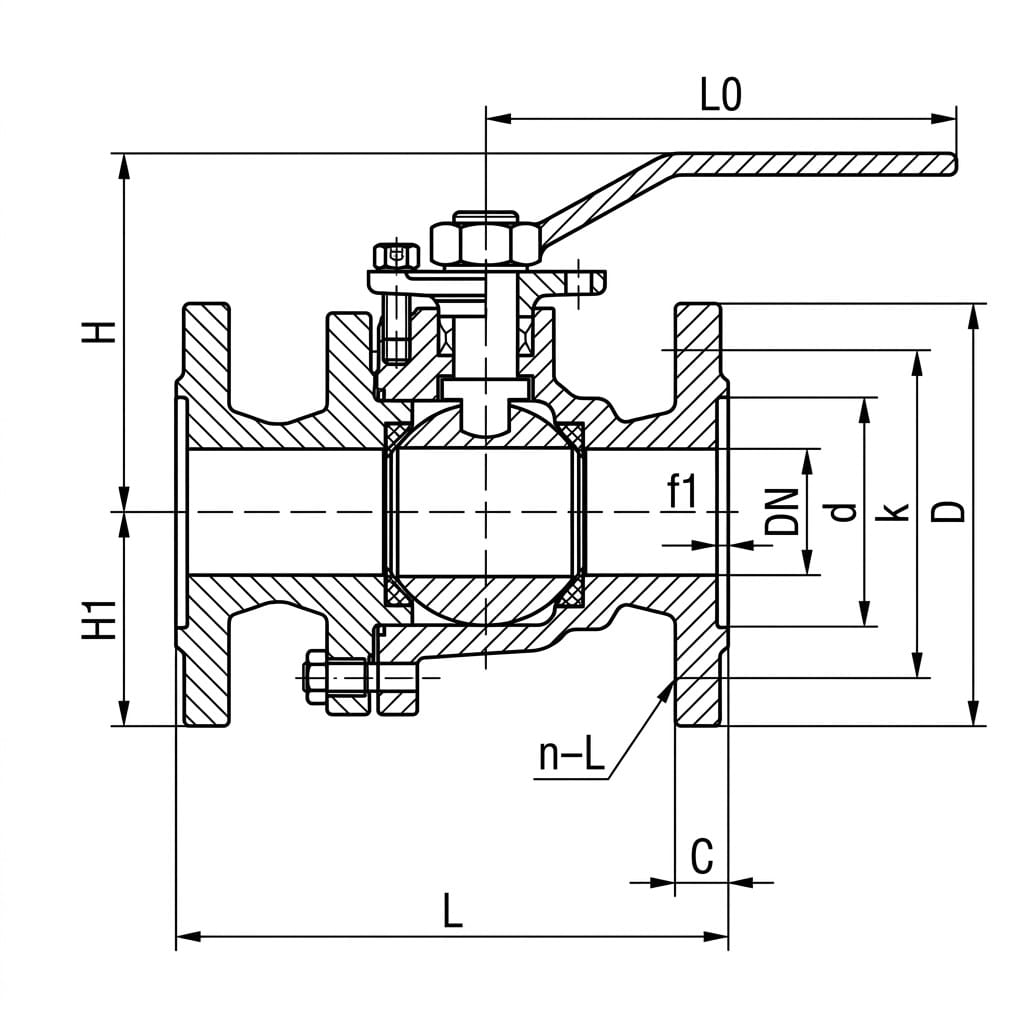
L = face-to-face length, H = height with handle, L0 = handle length. All in millimetres, weights in kilograms. Figures are for reference; certified drawings are issued with the quotation.
PN16
| Nominal Size | L | H | L0 | Weight |
|---|---|---|---|---|
| DN20 | 140 | 105 | 150 | 4 |
| DN25 | 160 | 110 | 150 | 5 |
| DN32 | 165 | 115 | 150 | 9 |
| DN40 | 180 | 122 | 160 | 10 |
| DN50 | 200 | 122 | 160 | 13 |
| DN65 | 220 | 130 | 200 | 17 |
| DN80 | 250 | 142 | 350 | 20 |
| DN100 | 280 | 152 | 350 | 34 |
| DN125 | 320 | 162 | 400 | 47 |
| DN150 | 360 | 182 | 400 | 51 |
| DN200 | 457 | 312 | 800 | 120 |
PN25
| Nominal Size | L | H | L0 | Weight |
|---|---|---|---|---|
| DN20 | 140 | 105 | 150 | 4 |
| DN25 | 160 | 110 | 150 | 5 |
| DN32 | 165 | 115 | 150 | 9 |
| DN40 | 180 | 122 | 160 | 10 |
| DN50 | 200 | 122 | 160 | 14 |
| DN65 | 220 | 130 | 200 | 15 |
| DN80 | 250 | 142 | 350 | 24 |
| DN100 | 280 | 152 | 350 | 38 |
| DN125 | 320 | 162 | 400 | 52 |
| DN150 | 360 | 260 | 600 | 93 |
| DN200 | 457 | 312 | 800 | 120 |
PN40
| Nominal Size | L | H | L0 | Weight |
|---|---|---|---|---|
| DN20 | 152 | 185 | 190 | 5 |
| DN25 | 185 | 85 | 190 | 6 |
| DN32 | 178 | 110 | 220 | 11 |
| DN40 | 190 | 135 | 250 | 12 |
| DN50 | 230 | 230 | 250 | 17 |
| DN65 | 216 | 142 | 270 | 18 |
| DN80 | 283 | 173 | 350 | 29 |
| DN100 | 305 | 183 | 400 | 45 |
| DN125 | 380 | 250 | 450 | 60 |
| DN150 | 403 | 340 | 500 | 107 |
| DN200 | 502 | 395 | 1500 | 138 |
PN63
| Nominal Size | L | H | L0 | Weight |
|---|---|---|---|---|
| DN20 | 190 | 216 | 229 | 5 |
| DN25 | 216 | 95 | 229 | 6 |
| DN32 | 241 | 112 | 241 | 11 |
| DN40 | 250 | 132 | 250 | 15 |
| DN50 | 280 | 145 | 270 | 20 |
| DN65 | 320 | 169 | 350 | 22 |
| DN80 | 360 | 182 | 350 | 35 |
| DN100 | 450 | 302 | 600 | 53 |
| DN125 | 500 | — | 800 | 69 |
| DN150 | — | 330 | 1000 | 123 |
| DN200 | — | — | — | — |
Structure Drawing
Design & Manufacturing Standards
- Design Standard: GB/T 12237 (flanged ball valves)
- Face-to-Face Dimensions: GB/T 12221
- Flange Standards: GB/T 9113, JB/T 79, HG/T 20592, ASME B16.5 (optional)
- Testing & Inspection: GB/T 13927, API 598, ISO 5208
- Ductile Iron Material: QT450-10 per GB/T 1348
- Cast Steel Material: WCB per ASTM A216
- Applicable International Standards: API 6D, BS 5351 (optional)
Ball Valve, Gate Valve or Butterfly Valve: Which to Quote
All three can isolate a line, but they differ in cost, space, speed and how well they seal after sitting idle. This is the question our engineers get asked most often before an order.
| Consideration | Q41F ball valve | Gate valve | Butterfly valve |
|---|---|---|---|
| Operation | 90-degree quarter turn, lever or gear | Multiple turns, rising or non-rising stem | Quarter turn, lever or worm gear |
| Shut-off quality | Bubble-tight on PTFE seats, seals well after long idle periods | Metal wedge seat; needs full open or full close, seats wear if throttled | Resilient or triple-eccentric seat; good, less positive than ball |
| Space and weight | Compact, moderate weight | Tallest of the three, needs stroke room above | Shortest and lightest, best for tight shafts |
| Pressure drop | Minimal, bore-aligned when open | Minimal when fully open | Disc sits in the flow, so slightly higher loss |
| Best for | Frequent isolation, pump discharge, branch lines | Main headers rarely operated | Large DN water and HVAC mains on a budget |
| Avoid when | Throttling, or above 200°C with soft seat | Space is limited, fast operation needed | High differential, erosion or cavitation risk |
Installation & Maintenance Guidelines
- Pipeline preparation: flush the line and remove welding slag, scale and debris before fitting; particles are the most common cause of seat leakage on a new installation. Use gaskets matched to the flange face.
- Position: the valve may be fitted in horizontal or vertical pipe. Keep the bonnet clear of puddled water outdoors, and support the pipe so its weight is not carried by the body.
- Flow direction: most Q41F models are bidirectional, but check the cast arrow on the body where a unidirectional seat is supplied.
- Flange bolting: align the faces, then tighten in a cross pattern over several passes. Do not pull one side up first — that distorts the body and binds the ball.
- Operation: run the valve only between fully open and fully closed. Never throttle with a ball valve; on large sizes pause near mid-travel to equalise pressure across the ball before completing the turn.
- Packing: if the gland weeps, re-tighten in increments of no more than a 1/6 turn while cycling the handle. Over-tightening scores the stem and raises torque; replace the packing rings if leakage continues.
- Seats: PTFE wears and cold-flows with cycle count. Inspect annually and replace upstream and downstream seats as a pair when the valve no longer holds seat test pressure.
- Lubrication: rebuild with a thin film of silicone or PTFE-compatible grease. Never use hydrocarbon grease on PTFE. Lubricate the stem threads to keep the handle smooth.
Application Fields
The Q41F is used wherever a line has to be isolated quickly and dependably: water supply distribution networks, steam boiler feedwater systems, oil refinery process pipelines, petroleum storage terminals, chemical plants, HVAC heating and cooling circuits, fire protection systems, industrial compressed air lines and general plant isolation. Choose the WCB cast steel models for steam and petroleum duty, the ductile iron models for water and oil at PN16–PN25, and CF8 stainless where corrosion or cleanliness is the driver.
What We Need to Quote Your Q41F Valves
- Size and quantity: DN20–DN200, mixed sizes welcome.
- Pressure class: PN16, PN25, PN40 or PN63.
- Body material: ductile iron, WCB cast steel or CF8 stainless — or tell us the medium and we will select it.
- Temperature and medium: water, steam, oil, gas or process fluid, with the maximum temperature.
- Operation: lever, bevel gear, or ready for pneumatic/electric actuation.
- Flange standard: GB/T 9113 or JB/T 79 as standard; EN 1092 or ASME B16.5 on request.
- Documentation: EN 10204 3.1 certificates, test records, CE or API 6D for tender packages.
Send a piping material specification or a valve list and we will return sizes, torque figures, actuator recommendation and pricing together. Datasheets and CAD files are in the download center; qualification documents are on the certifications page.
Frequently Asked Questions
Contact Gaoshan Valve for dimension sheets, CAD drawings, material certificates and a torque-checked Q41F selection for your water, steam, oil or process pipeline. Reply within 24 hours from our overseas sales desk.
Get a Quote & Technical Support
Contact Gaoshan Valve for dimension sheets, CAD drawings, material certificates and a torque-checked Q41F selection for your water, steam, oil or process pipeline. Reply within 24 hours from our overseas sales desk.