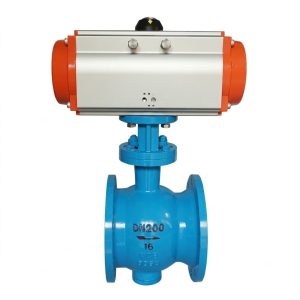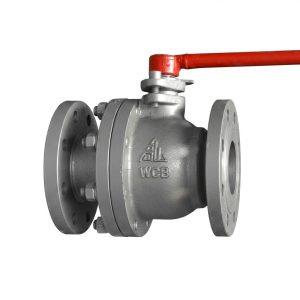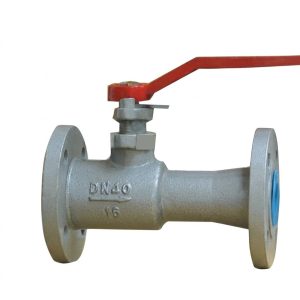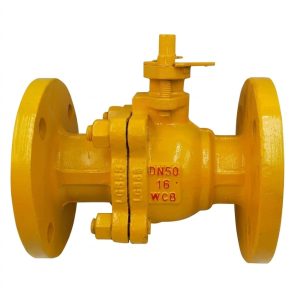
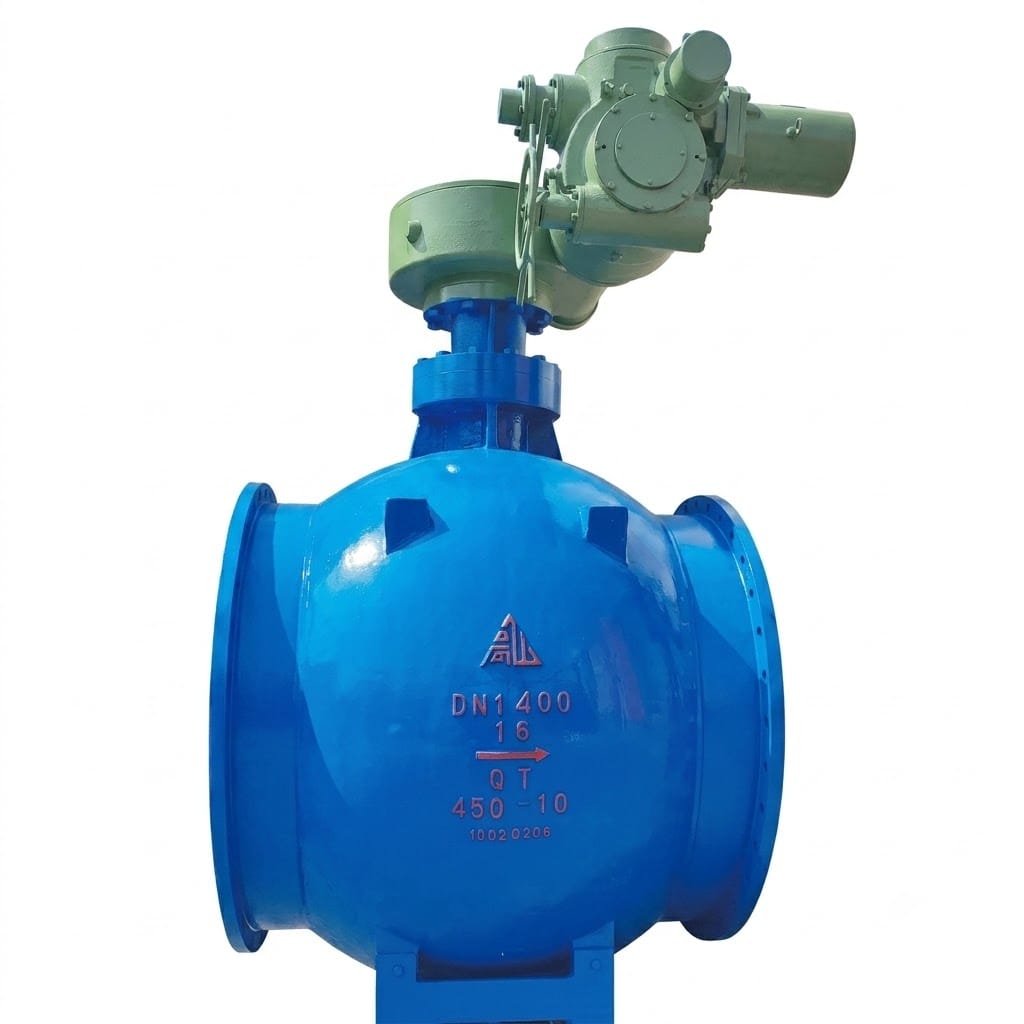
BQ340H Eccentric Semi-Ball Valve
Gaoshan BQ340H is an eccentric semi ball valve built for the media that destroy conventional ball valves — slurry, dregs, sewage and particle-laden fluids.
• Eccentric geometry: the disc wipes the seat only at the final moment of closure — particles cannot pack between the sealing faces
• Hard alloy (stellite-equivalent) sealing on both disc and seat — self-compensating as micro-wear occurs
• Zero-friction opening and closing — far lower torque than same-size gate valves, longer seat life in abrasive duty
• PN10 to PN40, DN50 – DN1600, -29°C to +425°C; carbon steel body, stainless stem
• Worm gear, electric or pneumatic actuation on a common ISO 5211 pad
• Full-bore flow plus throttling capability — isolation and regulation in one valve
Contact Us for Pricing
Interested in this product? Contact us now for detailed pricing and product information.
Product Details
An eccentric semi ball valve built for the media that destroy conventional ball valves: slurry, dregs, sewage and particle-laden fluids. The BQ340H’s disc wipes the seat only at the final moment of closure — particles cannot pack between the sealing faces — while hard alloy (stellite-equivalent) sealing surfaces self-compensate as micro-wear occurs. Carbon steel body, stainless stem, PN10–PN40, DN50–DN1600, −29 °C to +425 °C, with worm gear, electric or pneumatic actuation on a common ISO 5211 pad.
What the Model Code Means
| Symbol | Meaning |
|---|---|
| B | Semi-ball (eccentric half-ball) valve family — GB/T 26146 type |
| Q | Ball valve class |
| 3 | Worm gear operation (electric / pneumatic versions: BQ641H, BQ941H) |
| 4 | Flanged connection |
| 0 | Full-bore straight-through structure |
| H | Hard alloy (stellite-equivalent) sealed seating surfaces |
Eccentric Semi Ball Valve — Key Advantages
Eccentric Geometry — Zero-Friction Opening & Closing
The sealing surface sits on an axis eccentric to the valve spindle. As the disc rotates, the sealing face separates from or contacts the seat instantly — eliminating the continuous sliding friction that destroys conventional ball and butterfly valve seats in slurry service. 90° operation with dramatically lower torque than same-size gate valves.
Self-Compensating Hard Alloy Seating
Eccentricity keeps disc and seat in sustained preload contact, so any micro-wear is automatically compensated as the mechanism presses the disc harder toward the seat — sealing performance self-corrects over service life instead of degrading. Stellite-equivalent overlay on both faces resists abrasion, erosion and corrosion beyond stainless steel.
Handles Impurity-Laden Media That Destroy Conventional Valves
Conventional ball and butterfly valves fail catastrophically in slurry and particle-laden service because solids trap between the seating faces. The eccentric opening means the faces only meet at the final moment of closure — nothing packs between them during the stroke. This is the definitive valve for water treatment, mining, power plant ash handling, paper mills and dredging.
Full-Bore Flow Plus Throttling Capability
When fully open the semi-spherical disc swings completely out of the flow path; the profile also allows precise intermediate positioning for throttling — isolation and regulation in one valve, reducing total valve count in complex systems.
One Platform, Any Actuation
Worm gear handwheel, electric and pneumatic versions share the same body and ISO 5211 mounting pad — manual operation for remote lines, DCS-integrated electric control, or spring-return pneumatic emergency shutdown, without body modification.
Performance Specifications by Model
| Model | PN | DN Range | Seal Test (MPa) | Strength Test (MPa) | Pneumatic Seal (MPa) | Temp. Range |
|---|---|---|---|---|---|---|
| BQ340H-10C | 10 | DN50 – DN1600 | 1.1 | 1.5 | 0.6 | −29 °C ~ +425 °C |
| BQ340H-16C | 16 | DN50 – DN1000 | 1.8 | 2.4 | 0.6 | −29 °C ~ +425 °C |
| BQ340H-25 | 25 | DN50 – DN600 | 2.8 | 3.8 | 0.6 | −29 °C ~ +425 °C |
| BQ340H-40 | 40 | DN50 – DN500 | 4.4 | 6.0 | 0.6 | −29 °C ~ +425 °C |
Materials of Main Parts
| Part | Material |
|---|---|
| Valve body | Carbon steel |
| Disc (semi-ball) | Carbon steel |
| Valve stem | Stainless steel |
| Sealing surface | Hard alloy overlay (stellite equivalent) |
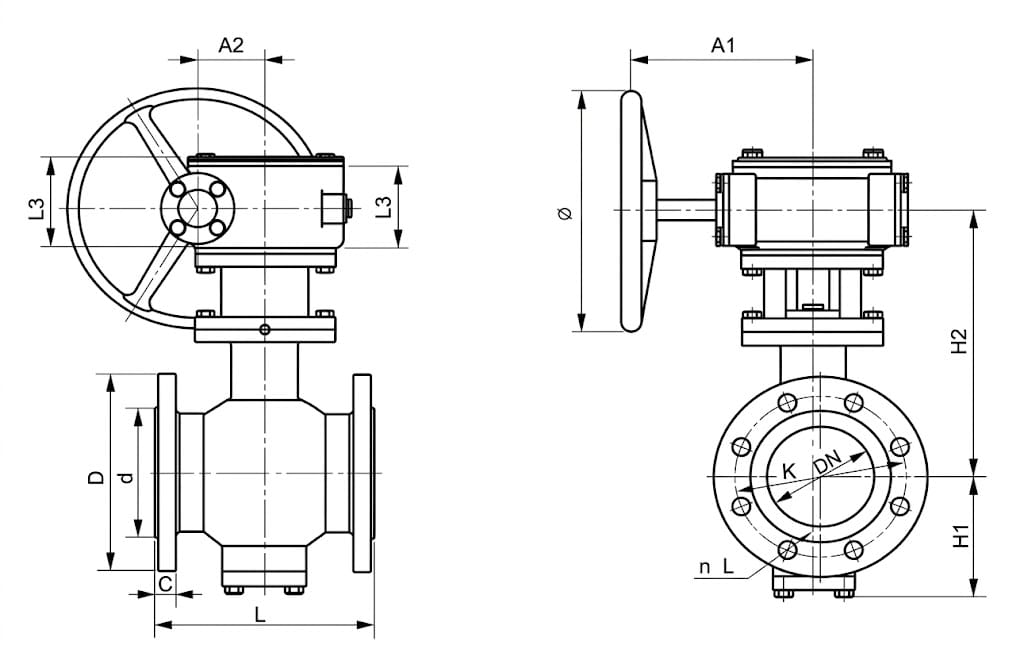
Main Dimensions — PN10 Series (DN50–DN1600)
| DN | L (mm) | H1 (mm) | H2 (mm) | A1 (mm) | A2 (mm) | φ (mm) |
|---|---|---|---|---|---|---|
| 50 | 178 | 100 | 200 | 120 | 43 | 200 |
| 65 | 190 | 100 | 251 | 120 | 43 | 200 |
| 80 | 203 | 125 | 265 | 120 | 43 | 200 |
| 100 | 229 | 135 | 275 | 200 | 64 | 240 |
| 125 | 254 | 150 | 290 | 200 | 64 | 240 |
| 150 | 267 | 173 | 330 | 232 | 93 | 300 |
| 200 | 292 | 195 | 375 | 232 | 93 | 300 |
| 250 | 330 | 225 | 432 | 276 | 132 | 420 |
| 300 | 356 | 260 | 470 | 276 | 132 | 420 |
| 350 | 440 | 300 | 575 | 425 | 185 | 500 |
| 400 | 500 | 320 | 600 | 425 | 185 | 500 |
| 450 | 560 | 350 | 625 | 425 | 185 | 500 |
| 500 | 620 | 400 | 710 | 480 | 233 | 600 |
| 600 | 680 | 400 | 710 | 480 | 233 | 600 |
| 700 | 760 | 520 | 860 | 525 | 296 | 600 |
| 800 | 840 | 570 | 910 | 525 | 296 | 600 |
| 900 | 1050 | 620 | 960 | 525 | 296 | 700 |
| 1000 | 1200 | 670 | 1010 | 580 | 360 | 700 |
| 1200 | 1500 | 720 | 1080 | 620 | 400 | 700 |
| 1400 | 1650 | 800 | 1100 | 700 | 480 | 800 |
| 1600 | 1850 | 880 | 1200 | 800 | 600 | 900 |
L = face-to-face; H1 = height (closed); H2 = overall height (open, incl. actuator); A1 = actuator width; A2 = stem eccentricity offset; φ = handwheel diameter. PN16/PN25/PN40 dimensions for DN50–DN500 (PN16 to DN1000) match the PN10 series — full sheets on request.
Structure Drawing
Design & Manufacturing Standards
- Design standard: GB/T 12237 (flanged ball valves) and GB/T 26146 (eccentric semi ball valve)
- Face-to-face: GB/T 12221 · Flange connection: GB/T 9113
- Testing & inspection: GB/T 13927 · Pneumatic sealing test 0.6 MPa across all PN classes
- Carbon steel body and disc per GB/T carbon steel casting standards; austenitic stainless stem
- Hard alloy sealing surface: stellite-equivalent overlay (wear & corrosion resistant)
- Actuator mounting: ISO 5211 — worm gear, electric and pneumatic compatible
Installation & Commissioning
- Flush the line first: even small abrasive particles left in the pipe can score the hard alloy seats on first stroke; fit a temporary strainer during commissioning and remove it after the line is clean.
- Any orientation: spindle may be horizontal, vertical-up or vertical-down without performance impact — just verify handwheel clearance (H2) against headroom.
- Flange bolting: align concentrically, insert all bolts, then tighten diametrically opposite in three passes; use spiral-wound metallic gaskets for PN25/PN40.
- Stroke check: cycle open-close at least twice before pressurizing; verify end stops and position indicator, and dry-run actuated versions for limit-switch calibration.
- Eccentricity: factory-set — never adjust the eccentric offset in the field. If seating is poor, check for flange-induced body stress.
Application Fields
- Water treatment and sewage handling with particle-laden media
- Mining slurry and power plant ash handling lines
- Paper mill stock and dregs service
- Dredging and land reclamation pipelines
- Petroleum, chemical and metallurgical process lines carrying impurities
Frequently Asked Questions
What is an eccentric semi ball valve?
A quarter-turn valve whose half-spherical disc sits on an axis eccentric to the spindle. The disc swings clear of the seat during travel and only wipes onto it at the final moment of closure, so abrasive particles cannot pack between the sealing faces — the reason it outlives conventional ball valves in slurry, sewage and ash service.
Why doesn’t it jam on slurry like a normal ball valve?
In a conventional ball valve the seat rubs against the ball through the entire 90° stroke, so trapped particles grind the sealing surfaces. The eccentric design keeps the faces apart until the last degrees of travel, then wedges them together with a force proportional to line pressure — wiping, not grinding.
BQ340H vs a standard Q41F ball valve — which for dirty media?
For clean water, gas and general isolation the Q41F floating ball valve is more economical. Once the medium carries sand, dregs, fibers or ash, the PTFE seats of a standard ball valve scar quickly — that is the eccentric semi ball valve’s territory, with hard alloy faces that self-compensate for wear.
Which actuation options are available?
Worm gear handwheel as standard, plus electric multi-turn and pneumatic spring-return versions — all sharing the same body and an ISO 5211 mounting pad, so actuation can be changed without replacing the valve.
What pressure classes and sizes are covered?
PN10 (DN50–DN1600), PN16 (DN50–DN1000), PN25 (DN50–DN600) and PN40 (DN50–DN500), from −29 °C to +425 °C. A pneumatic seat test at 0.6 MPa is applied uniformly across all classes.
Valving a slurry or sewage line?
Send Gaoshan Valve your media and line data for a factory-direct eccentric semi ball valve quote.