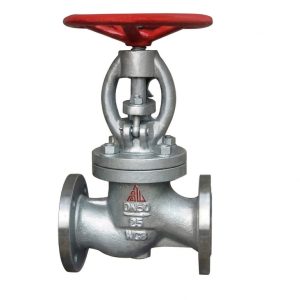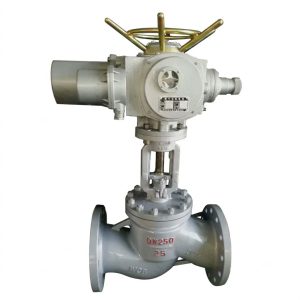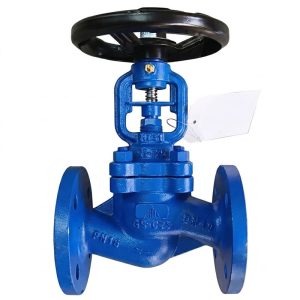
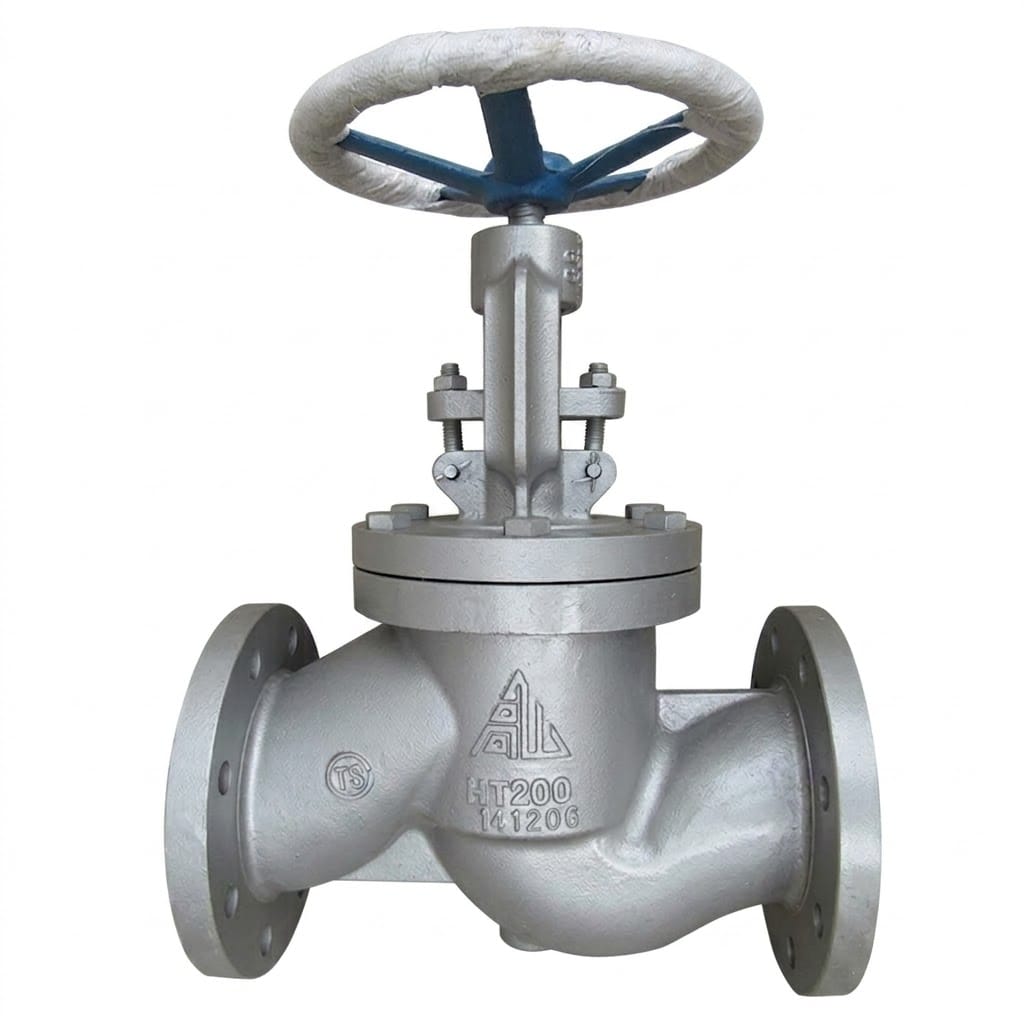
J41H(Y) Type Globe Valve
Gaoshan J41H / J41Y is a flanged rising stem globe valve for isolating and throttling water, steam and oil lines — from gray cast iron up to Cr-Mo steel for power-station steam.
*T-pattern globe design with parabolic disc — proven throttling and tight shut-off, unlike gate or ball valves
*Rising stem gives visible open position and accurate flow control
*Seat facing: stainless (J41H) or hard alloy / stellite (J41Y) for severe steam and hydrocarbon service up to 550°C
*Body range: gray iron, ductile iron, WCB carbon steel to Cr-Mo steel — PN16 through PN160
*Graphite packing rated for hot service; bonnet bolts and packing re-tightenable in service
*DN20 – DN300; flanged ends to GB / ANSI B16.5 / EN 1092 on request
*Flow direction: medium enters under the disc — arrow on body must match pipe flow
Contact Us for Pricing
Interested in this product? Contact us now for detailed pricing and product information.
Product Details
The J41H / J41Y flanged globe valve — the pattern overseas buyers also search as a stop valve or throttle valve — is the valve you specify when the job is regulation, not just isolation: a guided disc travels square onto its seat so flow can be set anywhere between closed and open without wiring the seat. The outside screw and yoke (OS&Y) rising stem shows position at a glance, and the body range — gray iron to chrome-molybdenum steel, PN16 to PN160, DN20 to DN300 — covers water, steam and oil from building services up to power-station conditions.
- Flanged rising-stem (OS&Y) globe valve — the standard pattern for throttling and regulation
- PN16–PN160, DN20–DN300, straight-through or Y-pattern flow path
- Body matched to service: gray iron, ductile iron, WCB cast steel, chrome-molybdenum steel
- 2Cr13 stainless stem and disc, cast aluminium bronze stem nut, flexible graphite packing
- Hard alloy (stellite) seat and disc on J41Y-160I for high-pressure steam and hydrocarbon duty
- J41W-16P all-stainless (CF8/CF8M) variant for corrosive media
Product Overview
A globe valve closes by pressing a disc straight down onto its seat along the stem axis. That geometry is what makes it a regulating valve: at any point between closed and open the disc-to-seat gap meters the flow, and the seat is never dragged across the sealing face the way a gate or ball is, so it can be throttled for years without losing its shutoff. The J41H / J41Y series is that pattern in flanged, rising-stem form, from PN16 water duty to PN160 high-pressure steam.
Body material follows the service. Gray cast iron and ductile iron cover general water to 200–300°C; WCB carbon steel takes steam and oil to 425°C; chrome-molybdenum steel handles power-generation and refinery conditions to 550°C. The J41Y-160I adds stellite hard-alloy surfacing on the disc and seat for erosion and cavitation resistance on severe steam and hydrocarbon duty, and the J41W-16P offers all-stainless construction for corrosive media.
Because the flow path turns through the body, a globe valve drops more pressure than a gate or ball of the same size. That is the accepted trade for being able to regulate. Where you only need on/off isolation with minimum loss, a gate or ball valve is the cheaper answer; where you need to set and hold a flow, the globe is the right tool.
What the Model Code Means
J = globe (stop) valve, 4 = flanged connection, 1 = straight through pattern, H = stainless steel seat facing and Y = hard-alloy facing; the number is the pressure class and the letter behind it the body material (Q ductile iron, C cast steel, I chrome-moly). Compare coding on the Valve Model Decoder. The bellows-sealed version for zero stem leakage is the WJ41H; the gas-service globe is the RJ41F.
Core Strengths
Built to Throttle, Not Just Isolate
The disc closes along the stem axis onto a seat it never slides across, so the valve can hold a set flow indefinitely without destroying its shutoff. That is the defining advantage over gate and ball valves, which are damaged by part-open operation.
Visible Position From a Rising Stem
The OS&Y construction means the stem rises as the valve opens, so an operator reads the position from the floor. On steam and high-pressure lines where a valve left open by mistake is a hazard, that indication is a safety feature.
Body Material Matched to Temperature
Gray iron to 200°C, ductile iron to 300°C, WCB to 425°C and chrome-moly to 550°C, all on the same pattern. Specifying by temperature rather than by habit is how the series stays economical across a plant.
Stellite Facing for Severe Duty
On the J41Y-160I the disc and seat carry hard-alloy (stellite) surfacing, which resists the wire-drawing, cavitation and erosion that destroy a plain stainless seat on high-pressure steam let-down and hydrocarbon throttling.
Graphite Packing for Hot Service
Flexible graphite gland packing holds its seal across the temperature range where PTFE would degrade, and can be re-tightened or repacked in line without removing the valve.
Directional, Positive Shutoff
Flow is directed under the disc so line pressure assists closure. Installed to the cast arrow, the valve seats tighter as differential rises — the reason globe valves remain the default stop valve on boiler and steam headers.
Performance Specifications
| Model | Nominal Pressure (MPa) | Shell Test (MPa) | Seal Test (MPa) | Max. Temp. (°C) | Body Material |
|---|---|---|---|---|---|
| J41H-16(O) | 1.6 | 2.4 | 1.8 | 200 | Gray Cast Iron |
| J41H-16C | 1.6 | 2.4 | 1.8 | 425 | WCB Cast Steel |
| J41H-25Q | 2.5 | 3.8 | 2.8 | 300 | Ductile Cast Iron |
| J41H-25 | 2.5 | 3.8 | 2.8 | 425 | WCB Cast Steel |
| J41H-40 | 4.0 | 6.0 | 4.4 | 425 | WCB Cast Steel |
| J41H-63 | 6.3 | 9.45 | 6.93 | 425 | WCB Cast Steel |
| J41H-100 | 10.0 | 15.0 | 11.0 | 550 | Chrome-Moly Steel |
| J41Y-160I | 16.0 | 24.0 | 17.6 | 550 | Chrome-Moly Steel |
Applicable medium for all models: water, steam, oil and petroleum products. The J41W-16P stainless variant covers corrosive media — send the medium and we will confirm the trim.
Main Component Materials
| Component | Material |
|---|---|
| Valve Body / Bonnet | Gray Cast Iron / Ductile Iron / WCB / Cr-Mo Steel (per model) |
| Disc / Seat | 2Cr13 Stainless Steel (Hard Alloy for J41H-100 / J41Y-160I) |
| Valve Stem | 2Cr13 Stainless Steel (Cr-Mo Steel for J41H-100 / J41Y-160I) |
| Stem Nut | Cast Aluminum Bronze |
| Packing | Flexible Graphite |
| Handwheel | Ductile Cast Iron |
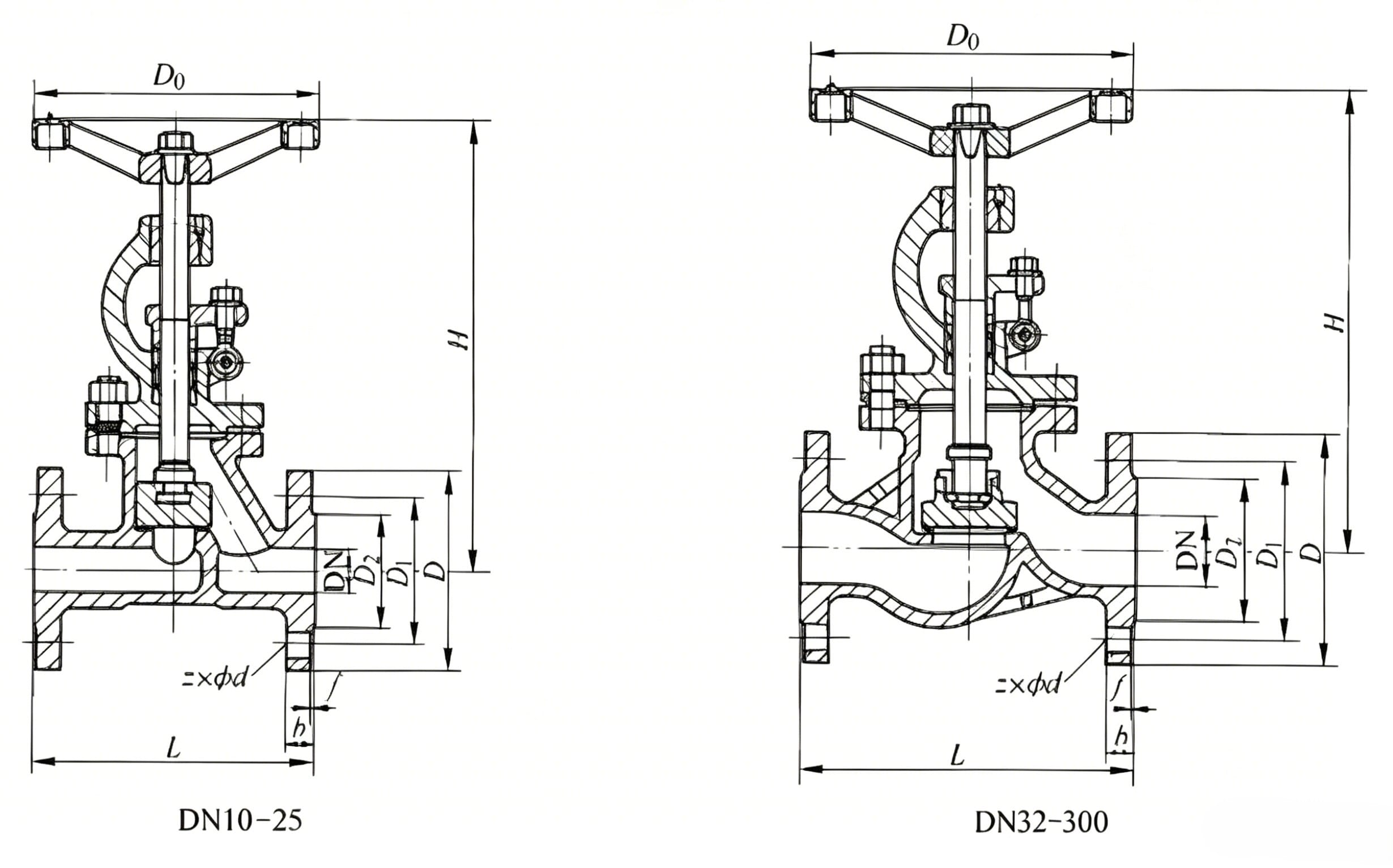
Main Dimensions & Weights (PN16)
DN20 – DN100
| Nominal size | L (face-to-face) | H (closed) | H1 (open) | D0 (handwheel) | Weight (kg) |
|---|---|---|---|---|---|
| DN20 | 150 | 154 | 182 | 120 | 4.5 |
| DN25 | 160 | 156 | 184 | 120 | 5 |
| DN32 | 180 | 182 | 206 | 160 | 6.5 |
| DN40 | 200 | 182 | 206 | 160 | 8.5 |
| DN50 | 230 | 188 | 225 | 160 | 12 |
| DN65 | 290 | 342 | 382 | 200 | 25 |
| DN80 | 310 | 347 | 408 | 240 | 32 |
| DN100 | 350 | 365 | 453 | 240 | 42 |
DN125 – DN300
| Nominal size | L (face-to-face) | H (closed) | H1 (open) | D0 (handwheel) | Weight (kg) |
|---|---|---|---|---|---|
| DN125 | 400 | 422 | 486 | 280 | 50 |
| DN150 | 480 | 485 | 566 | 360 | 82 |
| DN200 | 600 | 568 | 648 | 480 | 138 |
| DN250 | 622 | 780 | 860 | 480 | 185 |
| DN300 | 698 | 820 | 900 | 520 | 225 |
Dimensions shown are for PN16; higher classes vary. Certified drawings and the PN25–PN160 size tables are issued with the quotation.
Globe, Gate or Ball: Which Valve for the Duty
| Duty | J41H/J41Y globe (this page) | Gate valve | Ball valve |
|---|---|---|---|
| Regulate / throttle flow | Yes — the disc meters flow without seat damage | No — part-open wires the seat | No — throttling erodes the seat |
| Tight on/off isolation | Good, directional | Excellent, low loss when open | Excellent, quarter-turn |
| Pressure drop when open | Higher — flow turns through the body | Minimal | Minimal |
| Speed of operation | Multi-turn | Multi-turn | Quarter-turn |
| Choose it when | You must set and hold a flow, or stop frequently | You only isolate, rarely operated | You need fast on/off |
Where stem leakage is unacceptable — toxic, volatile or expensive media — the bellows-sealed WJ41H closes the one leak path a packed globe cannot; for gas service use the RJ41F.
Structure Drawing
Design, Testing and Reference Standards
- Design Standard: GB/T 12233; wall thickness to GB/T 12224
- Face-to-Face Dimensions: GB/T 12221; flanges to GB/T 9113, JB/T 79, HG/T 20596
- Testing & Inspection: GB/T 13927, JB/T 9092
International Standards & Certification
- Also referenced to international equivalents on request: design to BS 1873 / EN 13709 / ASME B16.34, face-to-face ASME B16.10 / EN 558, flanges ASME B16.5 / EN 1092-1, testing API 598 / ISO 5208.
- Material certificates to EN 10204 3.1 are supplied with delivery.
- Flow coefficient Cv / Kv is available on request for sizing and regulation duty.
Installation & Maintenance Guidelines
- Body materials: Gray cast iron, ductile iron, WCB & chrome-molybdenum steel
- Applicable International Standards: API 598, ANSI B16.5, ISO 5208 (optional)
- Flow Direction: Install with flow direction matching the arrow cast on the valve body — globe valves are directional and will not seal properly if reversed.
- Mounting Orientation: Prefer vertical stem-up installation when possible; horizontal installation is acceptable but may require more frequent packing adjustment.
- Stem Clearance: Allow adequate clearance above the handwheel for full stem travel — the rising stem extends significantly when the valve is opened.
- Steam Service: Install a steam trap downstream to prevent condensate hammer which can damage the disc and seat surfaces.
- Packing Maintenance: Periodically inspect flexible graphite packing for leakage. Tighten the packing gland nuts evenly in small increments — overtightening accelerates stem wear.
- Leave the stem clear: the rising stem extends well above the handwheel when open; keep the stroke free of insulation and structure and re-check after any lagging work.
- Trap steam lines: fit a steam trap downstream so condensate cannot hammer the disc and seat.
Application Fields
The J41H / J41Y is the stop-and-regulate valve of process plants: power generation steam lines and boiler feed; chemical and refinery process control; oil and gas pipelines; steam distribution networks; industrial water and heating systems; any line where flow must be set, held and stopped reliably. For pure isolation choose a gate or ball valve; for zero stem leakage choose the bellows WJ41H.
What We Need to Quote Your J41H / J41Y Globe Valves
- Size and pressure class: DN20–DN300, PN16–PN160.
- Medium and temperature: decides the body material — iron, WCB or chrome-moly.
- Duty: regulating, on/off, or frequent cycling; this sets the seat facing.
- Seat facing: 2Cr13 standard; stellite hard alloy for severe steam/hydrocarbon let-down.
- Flange standard: GB/T 9113 as standard; EN 1092 or ASME B16.5 on request.
- Corrosive media: specify the J41W-16P stainless variant if applicable.
- Documentation: EN 10204 3.1 certificates and test records for tenders.
Send the line data sheet or P&ID and we will confirm class, body and seat facing for the duty. Drawings are in the download center and qualifications on the certifications page.
Frequently Asked Questions
Can a globe valve really throttle, unlike a gate or ball valve?
Yes – that is its purpose. The disc closes along the stem axis and never slides across the seat, so it can hold a set flow without damaging its shutoff. A gate or ball valve held part-open has its seat wire-drawn by the flow and soon leaks even when closed.
Why does a globe valve have to be installed in one direction?
Flow is directed under the disc so line pressure assists closure – the valve seats tighter as differential rises. Installed backwards it fights the pressure and will not seal. Follow the arrow cast on the body.
Which body material for steam at 425 or 550 degC?
WCB carbon steel to 425 degC; chrome-molybdenum steel to 550 degC on the J41H-100 and J41Y-160I. Gray iron stops at 200 degC and ductile iron at 300 degC. Give us the saturation pressure so the class is checked at temperature.
What does the J41Y-160I hard alloy seat buy me?
Stellite surfacing on the disc and seat resists wire-drawing, cavitation and erosion on high-pressure steam let-down and hydrocarbon throttling, where a plain stainless seat erodes quickly. It is the severe-duty option.
How much headroom does the rising stem need?
The stem extends above the handwheel by roughly the valve travel when open, so keep the full stroke clear of insulation, trays and structure. Check the H1 (open) dimension in the table and allow for it in the lagging design.
What sizes are available, and is a DN50 globe valve in stock range?
The series runs DN20 to DN300, so a DN50 globe valve is standard. The PN16 dimension table above lists DN20-DN300; higher pressure classes vary, and the PN25-PN160 size tables are issued with the quotation. Send the line size and class and we will confirm face-to-face.
When should I choose the bellows WJ41H instead?
When stem leakage is unacceptable – toxic, volatile or expensive media. The welded bellows seals the stem path hermetically, with a graphite gland as backup. For ordinary water/steam/oil regulation the packed J41H is the economical choice.
Get a Quote & Technical Support
Gaoshan Valve has manufactured industrial valves since 1975 and holds ISO 9001/14001/45001 with CE, API 6D and PED product certification. It is an approved supplier to Sinopec, CNPC and State Grid and exports to more than 30 countries, supplying power plants, refineries and EPC contractors. Contact us for dimension sheets, CAD drawings and a J41H / J41Y selection matched to your duty. Reply within 24 hours.