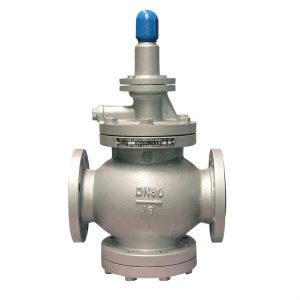
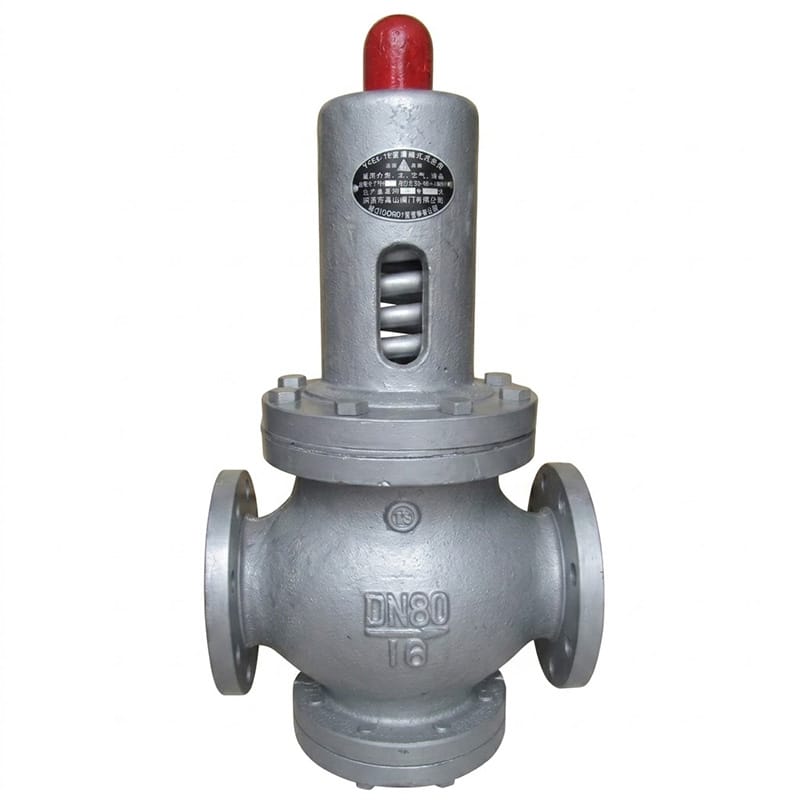
Y42X Spring Diaphragm Pressure Reducing Valve
Gaoshan Y42X is a self-operated, direct-acting pressure reducing valve — a spring-loaded NBR diaphragm holds downstream pressure steady using only the energy of the medium, with no electricity, air or control wiring.
*Smooth, chatter-free regulation — no stick-slip like piston-type reducers
*Outlet 0.05–1.0 MPa from inlet 0.25–1.6 MPa, held within ±15% across the flow range
*Two bodies: Y42X-16 ductile iron, Y42X-16C WCB cast steel — stainless stem and plunger
*PN16, DN40–DN200, flanged RF ends; water, oil and non-corrosive liquids to 70°C
*Proven on high-rise fire hydrant and sprinkler supply, municipal and building water
*Replaceable diaphragm kit; GB/T 12244 design, 100% shell and seat tested before shipment
Contact Us for Pricing
Interested in this product? Contact us now for detailed pricing and product information.
Product Details
The Y42X Spring Diaphragm Pressure Reducing Valve is a self-operated, direct-acting pressure reducer for water, oil and non-corrosive liquid lines — it cuts a higher inlet pressure down to a steady set outlet pressure using nothing but the energy of the medium. No electricity, no air supply, no control wiring. A flexible NBR diaphragm senses downstream pressure against an adjustable spring, giving smooth chatter-free regulation (±15% deviation) where piston-type reducers can stick-slip. DN40–DN200, PN16, inlet 0.25–1.6 MPa, outlet 0.05–1.0 MPa.
Product Overview
Y42X is the diaphragm-sensing member of our pressure reducing valve series. Unlike piston-type reducers, its NBR (Buna-N) diaphragm provides progressive throttling with fast response to changing flow demand — which is why it is the preferred pattern for high-rise building water supply, fire hydrant and sprinkler networks, and municipal distribution, where a consistent reduced pressure matters more than raw flow capacity.
What the Model Code Means
| Symbol | Meaning |
|---|---|
| Y | Pressure reducing valve |
| 4 | Flanged connection |
| 2 | Spring-loaded diaphragm actuation (direct acting) |
| X | Rubber (NBR) seat sealing |
| 16 / 16C | PN16; C = WCB cast steel body (no letter = ductile iron) |
Key Advantages
Smooth Diaphragm Actuation — No Chatter
The NBR diaphragm throttles progressively without the friction and stick-slip common in piston regulators, holding stable outlet pressure even at low flow — ideal for residential and commercial water systems.
Self-Operated — Zero External Energy
The valve runs on the medium’s own pressure energy. Install it, set the spring, and the diaphragm mechanism does the rest — no power supply or instrumentation to maintain.
Two Body Material Options
Y42X-16 in ductile cast iron for cost-effective general water service; Y42X-16C in WCB cast steel for higher structural integrity. Both run a stainless steel stem and plunger internally.
Proven in Fire Protection Duty
Delivers the consistent reduced pressure required by hydrant and sprinkler networks in high-rise buildings, replacing outdated conventional district water pipe regulators.
Wide-Area Diaphragm Sensing
The large effective diaphragm area converts small pressure changes into precise valve-position correction, holding outlet deviation within ±15% across the flow range.
Direct-Acting vs Pilot-Operated — Which Do You Need?
| Factor | Direct acting (Y42X) | Pilot operated |
|---|---|---|
| Power source | Medium pressure only | Medium pressure via internal pilot |
| Regulation accuracy | ±15% outlet deviation | Tighter, typically ±5–10% |
| Flow range | Good for moderate demand | Better turndown and high flow |
| Maintenance | Simple — diaphragm kit swap | More components to service |
| Cost | Lower | Higher |
| Best for | Building supply, fire protection, municipal distribution | Large networks, variable demand, tight control |
Need higher flow or tighter control on a piston-pattern body? See our Y43H piston type pressure reducing valve (PN16/PN25, DN20–DN300).
Technical Specifications
| Parameter | Y42X-16 | Y42X-16C |
|---|---|---|
| Nominal Pressure | PN16 | PN16 |
| Shell Test Pressure | 2.4 MPa | 2.4 MPa |
| Inlet Pressure Range | 0.25 – 1.6 MPa | 0.25 – 1.6 MPa |
| Outlet Pressure Range | 0.05 – 1.0 MPa | 0.05 – 1.0 MPa |
| Outlet Pressure Deviation | ±15% | ±15% |
| Nominal Diameter | DN40 – DN200 | DN40 – DN200 |
| Working Temperature | 0 °C – 70 °C | 0 °C – 70 °C |
| Body Material | Ductile cast iron | WCB cast steel |
| Suitable Medium | Water, oil, non-corrosive liquids | Water, oil, non-corrosive liquids |
| Connection | Flanged (RF) | Flanged (RF) |
| Regulation Type | Self-operated spring diaphragm, direct acting | Self-operated spring diaphragm, direct acting |
Main Parts & Materials
| Part | Y42X-16 | Y42X-16C |
|---|---|---|
| Body, upper & lower bonnet | Ductile cast iron | WCB cast steel |
| Stem / plunger | Stainless steel | Stainless steel |
| Main valve spring / regulating spring | Silicon-manganese steel | Silicon-manganese steel |
| Diaphragm | Buna-N rubber (NBR) | Buna-N rubber (NBR) |
| Seal ring | Buna-N rubber (NBR) | Buna-N rubber (NBR) |
How It Works
The Y42X works on a simple force balance. High-pressure medium enters and is throttled through the gap between main disc and seat, dissipating pressure energy. The reduced downstream pressure acts on the large underside of the NBR diaphragm, opposed by an adjustable regulating spring above it. When diaphragm force equals spring force, the valve holds a balanced throttling position.
If downstream pressure rises above set point (demand falls), the diaphragm pushes up, closing the disc and reducing flow. If pressure drops (demand rises), the spring pushes the diaphragm down, opening the disc to admit more flow. This continuous proportional feedback holds the outlet within ±15% of set point — with no external power or actuator.
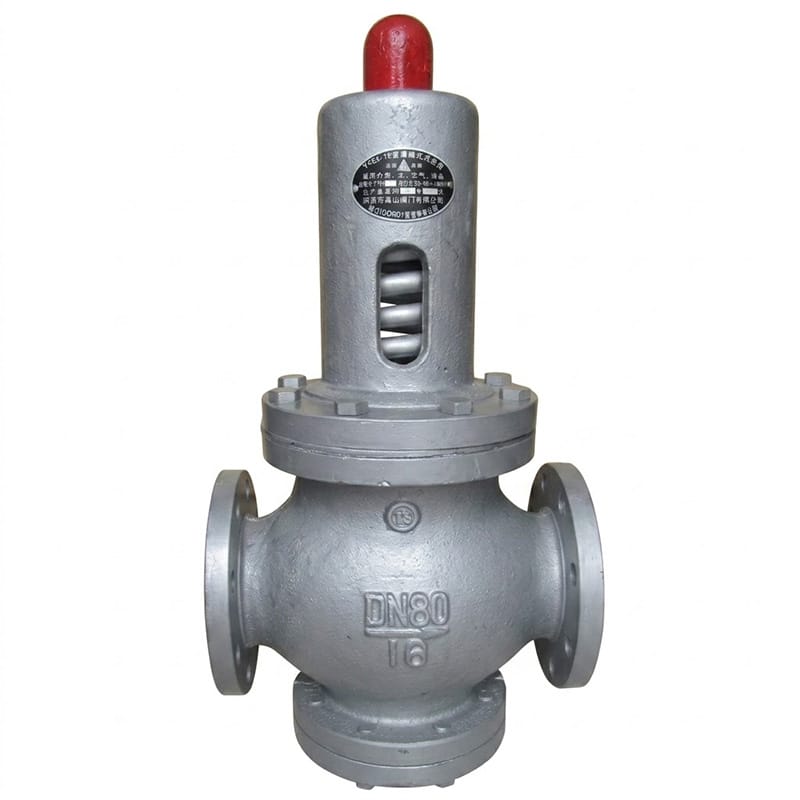
Dimensions & Weight
| DN | L Face-to-Face (mm) | H Center Height (mm) | H1 Total Height (mm) | Weight (kg) |
|---|---|---|---|---|
| 40 | 220 | 450 | 90 | 28 |
| 50 | 250 | 450 | 90 | 28 |
| 65 | 280 | 480 | 105 | 38 |
| 80 | 310 | 500 | 123 | 59 |
| 100 | 350 | 500 | 123 | 65 |
| 125 | 400 | 750 | 130 | 89 |
| 150 | 450 | 780 | 160 | 120 |
| 200 | 500 | 800 | 160 | 150 |
L = face-to-face; H = centre height above pipe centreline; H1 = overall height. Flange dimensions per GB/T 9113 / JB/T 79. Values are identical for Y42X-16 and Y42X-16C.
Installation Guidelines
- Install on a horizontal pipeline with the spring housing vertical — the diaphragm must stay horizontal to sense correctly.
- Fit a Y-type or T-type strainer upstream to protect diaphragm, seat and plunger from debris and scale.
- Fit pressure gauges upstream and downstream for set-point adjustment and monitoring.
- Provide a bypass line with a globe valve so the reducer can be serviced without shutting the system down.
- Allow at least 5 pipe diameters of straight run both sides for stable flow and accurate sensing.
- Commission with the regulating spring fully backed off, then tighten slowly while watching the outlet gauge to the set point.
- For fire protection service, lock the adjusting screw with a nut or tamper-proof cap after calibration.
- Inspect the diaphragm every 12 months for wear, cracking or hardening; replace if degraded. Avoid freezing locations — trapped water in the diaphragm chamber can burst it.
Application Fields
- Fire protection systems and high-rise building water supply
- Municipal water distribution and residential water systems
- Commercial plumbing and industrial water supply
- Oil transfer pipelines and HVAC chilled water circuits
Quality Standards & Certifications
- Design & manufacture: GB/T 12244 (pressure reducing valve)
- Face-to-face: GB/T 12221 · Flange ends: GB/T 9113 / JB/T 79
- Test & inspection: GB/T 13927 / GB/T 12245
- ISO 9001 quality management system certified
- TS special equipment manufacturing license
- 100% hydrostatic shell test at 1.5× rated pressure (2.4 MPa) before shipment
- 100% seat leakage test after shell test
Packaging & After-Sales
Each valve ships with protective flange end caps, sealed in a poly bag with desiccant inside a plywood or export crate, with extra impact protection for the spring housing and diaphragm assembly. Packing list, material certificate, hydrostatic test report and installation manual accompany every shipment; FOB, CIF and DAP terms supported.
18-month warranty from delivery. Technical support for set-point adjustment and commissioning; spare diaphragm kits, seal rings, plungers, springs and trim available, with on-site service on request.
Frequently Asked Questions
Do I need electricity or air to run a Y42X pressure reducing valve?
No. The Y42X is self-operated and direct acting — it uses the pressure energy of the medium itself to sense and regulate. You set the outlet pressure on the spring; there is nothing to wire or power.
Y42X diaphragm or Y43H piston — which pressure reducing valve should I choose?
Pick the Y42X diaphragm type for smooth, chatter-free control on water and light oil duty up to 70 °C — building supply, fire protection and municipal distribution, sizes DN40–DN200. Pick the Y43H piston type for larger bores (to DN300), higher pressure classes (PN25) or more demanding industrial service.
How accurate is the outlet pressure?
Outlet pressure holds within ±15% of the set point across the flow range. Set point is adjustable from 0.05 to 1.0 MPa with an inlet of 0.25 to 1.6 MPa.
Can the Y42X be installed on a vertical pipe?
The valve body is designed for horizontal pipelines with the spring housing upright so the diaphragm stays level. Do not mount it with the bonnet sideways or downward — diaphragm sensing accuracy suffers. Flow through the valve itself is not reversible like a check valve, but follow the direction marked on the body.
What maintenance does a diaphragm pressure reducing valve need?
Inspect the NBR diaphragm every 12 months for hardening, cracking or fatigue and replace as a kit; keep the upstream strainer clean so grit never reaches the seat. Diaphragm, seal ring, plunger and spring kits are stocked as spares.
Is the Y42X suitable for fire protection systems?
Yes — it is a common choice for reducing hydrant and sprinkler supply pressure in high-rise buildings, replacing older district regulators. After calibration, lock the adjusting screw with a tamper-proof cap and keep the bypass valve open for maintenance.
Need a set point, size or material we have not listed?
Contact Gaoshan Valve for pricing, sizing support and technical guidance on your water pressure regulation project.