
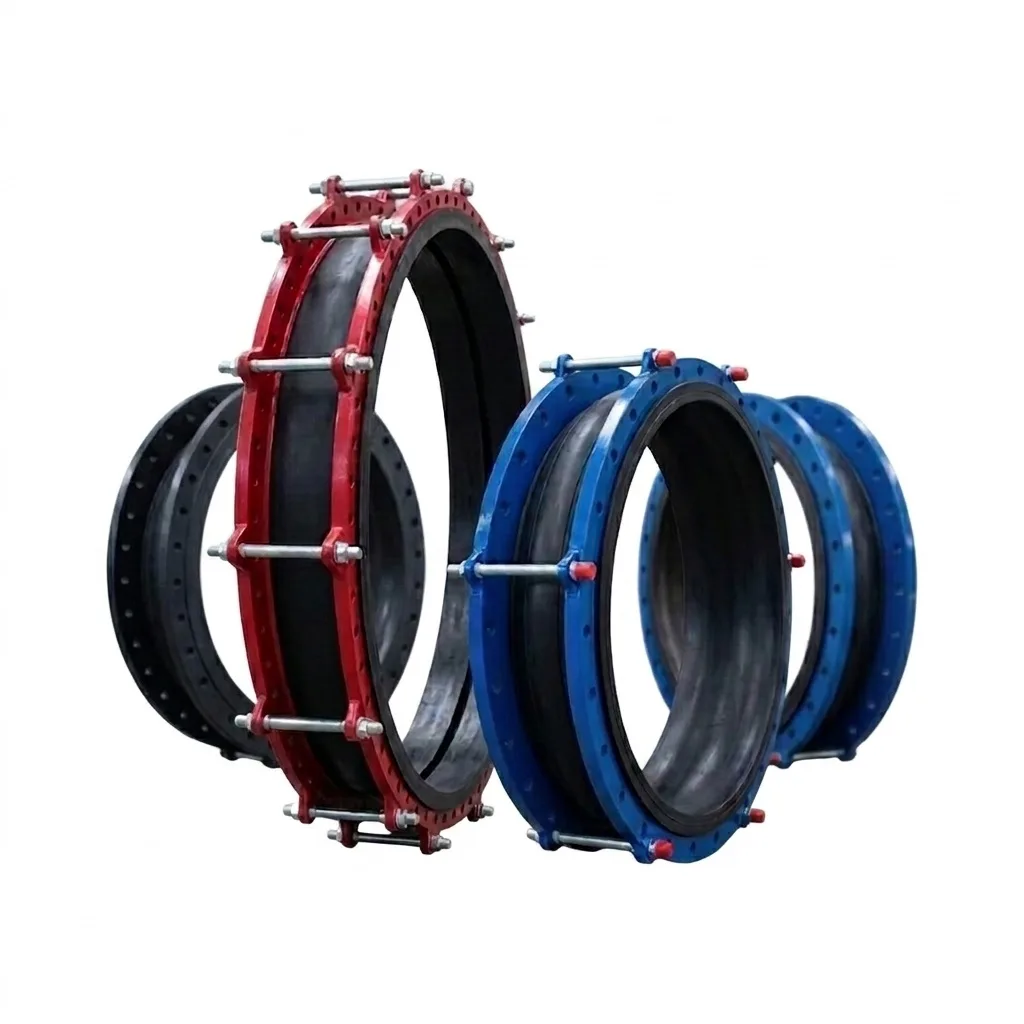
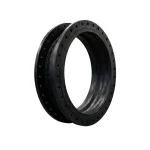
Single Sphere Rubber Expansion Joint
Single-arch reinforced rubber body: axial extension + compression, lateral and angular movement in one unit Damps pump/compressor vibration and isolates structure-borne noise Elastomer matched to service: EPDM, NBR, natural rubber, neoprene or SBR Swivel flanges in galvanized Q235 or SS304/316/316L, drilled to GB / ASME B16.5 / DIN / EN 1092 / JIS Burst pressure >= 3x working pressure (3:1 safety factor); vacuum to -650 mmHg No guides, packing or moving metal parts — zero routine maintenance
Contact Us for Pricing
Interested in this product? Contact us now for detailed pricing and product information.
Product Details
The single sphere rubber expansion joint — also specified as a flexible rubber connector, elastomeric expansion joint or anti-vibration flexible connector — is the compact answer to pump vibration, pipe noise and thermal movement. One reinforced rubber arch absorbs axial, lateral and angular displacement at the same time, so a single joint replaces a stack of hardware compensators. DN32 to DN5000, PN10/PN16/PN25, with the elastomer and flange drilled to your standard.
- Single-arch reinforced rubber body: axial extension + compression, lateral and angular movement in one unit
- Damps pump/compressor vibration and isolates structure-borne noise
- Elastomer matched to service: EPDM, NBR, natural rubber, neoprene or SBR
- Swivel flanges in galvanized Q235 or SS304/316/316L, drilled to GB / ASME B16.5 / DIN / EN 1092 / JIS
- Burst pressure ≥ 3× working pressure (3:1 safety factor); vacuum to −650 mmHg
- No guides, packing or moving metal parts — zero routine maintenance
Product Overview
A rubber expansion joint is a flexible connector, not a valve: it lives between two rigid pipe ends and takes up the movement, vibration and noise that would otherwise fatigue the line. The single-sphere pattern uses one reinforced rubber arch — high-tenacity nylon-cord plies vulcanized into the elastomer — with swiveling flanges that let the bolt holes line up without twisting the body during installation.
Because the arch is free to flex in every direction, one joint handles axial extension and compression, lateral offset and angular deflection simultaneously. That is why it is the default flexible connector at pump suction and discharge, chiller and cooling-tower connections, and riser take-offs, where thermal growth and equipment vibration concentrate.
Selection is two decisions: the elastomer (set by the medium and temperature — see the guide below) and the flange (set by your piping standard and corrosion requirement). Everything else follows from size and pressure.
Key Advantages
Vibration and Noise Isolation
The elastomer body damps mechanical vibration and structure-borne noise from pumps, compressors and chillers, protecting downstream pipe and extending the life of connected equipment. On a plant room riser this is the difference between a quiet building and a humming one.
Multi-Axis Movement in One Unit
Axial, lateral and angular movement are absorbed together, eliminating the need for separate compensators and simplifying the layout. The single arch gives the most movement for the shortest face-to-face length, which matters in tight plant rooms.
Elastomer Matched to the Medium
EPDM for hot water and mild chemicals, NBR for oils and fuels, natural rubber for abrasive slurries, neoprene for seawater and refrigerants, SBR for economical water service. The selection guide below maps each.
3:1 Burst Safety and Vacuum Rating
Multi-layer nylon-cord reinforcement gives a minimum 3:1 safety factor against burst, and the joint holds vacuum to −650 mmHg, so it survives pump-down and surge conditions that collapse an unreinforced connector.
Swivel Flanges, Any Standard
The flanges rotate independently of the body, so bolt holes align without stressing the arch. They are drilled to GB, ASME B16.5 Class 150/300, DIN, BS EN 1092 or JIS B2220, in galvanized carbon steel or stainless.
Zero Maintenance
No guides, packing or moving metal parts. Once installed and correctly supported, there is nothing to adjust or lubricate; the joint is inspected visually at shutdowns.
Elastomer Material Selection Guide
| Elastomer | Temperature Range | Recommended Media | Key Properties |
|---|---|---|---|
| EPDM | −15°C to +115°C | Hot water, steam condensate, mild acids, alkalis, cooling water | Excellent heat and ozone resistance; broad chemical compatibility with polar solvents; ideal for HVAC and water treatment. |
| NBR (Nitrile) | −15°C to +100°C | Oils, fuels, hydrocarbons, petroleum-based fluids | Superior oil and fuel resistance; good abrasion resistance; suitable for petrochemical and fuel transfer applications. |
| Natural Rubber (NR) | −20°C to +80°C | General water service, abrasive slurries, wastewater | High tensile strength and resilience; excellent abrasion resistance for slurry and solids-laden media. |
| Neoprene (CR) | −15°C to +100°C | Refrigerants, seawater, moderate chemicals | Good weathering and flame resistance; moderate oil and chemical resistance; suitable for refrigeration and marine service. |
| SBR | −15°C to +80°C | General water, sewage, non-aggressive fluids | Economical general-purpose option; good abrasion resistance; cost-effective for standard water and drainage applications. |
Technical Specifications
| Parameter | PN10 | PN16 | PN25 |
|---|---|---|---|
| Nominal Pressure | 1.0 MPa | 1.6 MPa | 2.5 MPa |
| Burst Pressure (Min.) | 3.0 MPa | 4.8 MPa | 7.5 MPa |
| Vacuum Rating | −650 mmHg (86 kPa) | −650 mmHg (86 kPa) | −650 mmHg (86 kPa) |
| Safety Factor | ≥ 3:1 (burst pressure ≥ 3 × rated working pressure) | ≥ 3:1 (burst pressure ≥ 3 × rated working pressure) | ≥ 3:1 (burst pressure ≥ 3 × rated working pressure) |
| Elastomer Body Material | EPDM / NBR / Natural Rubber / Neoprene / SBR (selectable) | EPDM / NBR / Natural Rubber / Neoprene / SBR (selectable) | EPDM / NBR / Natural Rubber / Neoprene / SBR (selectable) |
| Reinforcement | Multi-layer high-tenacity nylon-cord fabric (fully vulcanized) | Multi-layer high-tenacity nylon-cord fabric (fully vulcanized) | Multi-layer high-tenacity nylon-cord fabric (fully vulcanized) |
| Swivel Flange Material | Carbon Steel Q235 (galvanized or coated) / Stainless Steel 304 / 316 / 316L | Carbon Steel Q235 (galvanized or coated) / Stainless Steel 304 / 316 / 316L | Carbon Steel Q235 (galvanized or coated) / Stainless Steel 304 / 316 / 316L |
| Flange Standard | GB/T 9119 / ASME B16.5 (Class 150, Class 300) / DIN / BS EN1092 / JIS B2220 | GB/T 9119 / ASME B16.5 (Class 150, Class 300) / DIN / BS EN1092 / JIS B2220 | GB/T 9119 / ASME B16.5 (Class 150, Class 300) / DIN / BS EN1092 / JIS B2220 |
Dimensions & Movement Capability (PN10 / PN16)
DN32 – DN200
| Nominal size | Inch | L (install) | Axial ext. | Axial comp. | Lateral | Angular |
|---|---|---|---|---|---|---|
| DN32 | 1 1/4 | 95 | 6 | 9 | 9 | 15° |
| DN40 | 1 1/2 | 95 | 6 | 10 | 9 | 15° |
| DN50 | 2 | 105 | 7 | 10 | 10 | 15° |
| DN65 | 2 1/2 | 115 | 7 | 13 | 11 | 15° |
| DN80 | 3 | 135 | 8 | 15 | 12 | 15° |
| DN100 | 4 | 150 | 10 | 19 | 11 | 15° |
| DN125 | 5 | 165 | 12 | 19 | 13 | 15° |
| DN150 | 6 | 180 | 12 | 20 | 14 | 15° |
| DN200 | 8 | 210 | 16 | 25 | 22 | 15° |
DN250 – DN600
| Nominal size | Inch | L (install) | Axial ext. | Axial comp. | Lateral | Angular |
|---|---|---|---|---|---|---|
| DN250 | 10 | 230 | 16 | 25 | 22 | 15° |
| DN300 | 12 | 245 | 16 | 25 | 22 | 15° |
| DN350 | 14 | 255 | 16 | 25 | 22 | 15° |
| DN400 | 16 | 255 | 16 | 25 | 22 | 15° |
| DN450 | 18 | 255 | 16 | 25 | 22 | 10° |
| DN500 | 20 | 260 | 16 | 25 | 22 | 10° |
| DN600 | 24 | 260 | 16 | 25 | 22 | 10° |
| DN700 | 28 | 260 | 16 | 25 | 22 | 10° |
| DN800 | 32 | 260 | 16 | 25 | 22 | 10° |
DN700 – DN5000
| Nominal size | Inch | L (install) | Axial ext. | Axial comp. | Lateral | Angular |
|---|---|---|---|---|---|---|
| DN900 | 36 | 260 | 16 | 25 | 22 | 10° |
| DN1000 | 40 | 260 | 18 | 25 | 22 | 5° |
| DN1100 | 44 | 300 | 18 | 25 | 22 | 5° |
| DN1200 | 48 | 300 | 18 | 25 | 22 | 5° |
| DN1400 | 56 | 350 | 18 | 25 | 22 | 5° |
| DN1500 | 60 | 350 | 18 | 25 | 22 | 5° |
| DN1600 | 64 | 350 | 18 | 25 | 22 | 5° |
| DN1800 | 72 | 350 | 18 | 25 | 22 | 5° |
| DN2000 | 80 | 350 | 18 | 25 | 22 | 5° |
| DN2200 | 88 | 380 | 20 | 30 | 25 | 5° |
| DN2400 | 96 | 380 | 20 | 30 | 25 | 5° |
| DN2600 | 104 | 380 | 20 | 30 | 25 | 3° |
L = face-to-face install length. PN10 and PN16 share the same envelope; PN25 is identical to DN300 with a reinforced body. Sizes beyond DN2600 are made to order — send the duty and we will confirm dimensions.
Single Sphere, Double Sphere or Metal: Which Joint to Specify
| Duty | Single sphere rubber (this page) | Double sphere rubber | Metal bellows expansion joint |
|---|---|---|---|
| Movement per unit length | High in a short face-to-face | Higher, longer body | Lower, but handles heat |
| Temperature | To ~115°C (EPDM) | To ~115°C | To 400°C+ for steam/high temp |
| Vibration / noise isolation | Excellent | Excellent | Poor — metal transmits |
| Pressure / vacuum | PN10–25, vacuum OK | Lower pressure | High pressure |
| Choose it when | Pump connections, plant rooms, risers | Large movement, low pressure | Steam, high temp, hydrocarbon |
For high-temperature steam or hydrocarbon lines the metal bellows joint is the right answer; see the expansion joint series. For everything at water/HVAC temperatures the single sphere is the simplest, quietest choice.
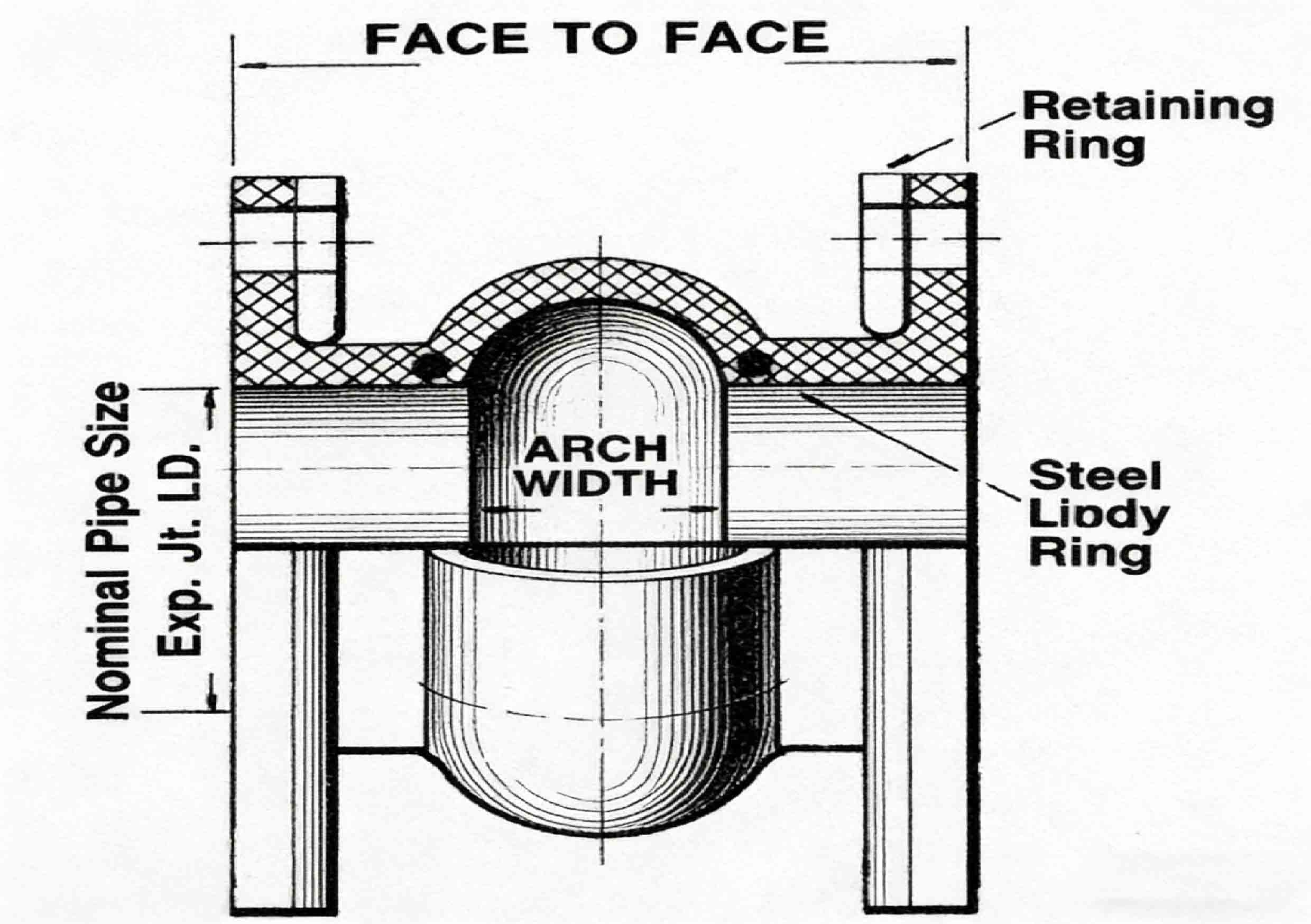
Structure Drawing
Design, Testing and Reference Standards
- Flange drilling: GB/T 9119, ASME/ANSI B16.5 Class 150/300, DIN, BS EN 1092, JIS B2220
- Reinforcement and safety: burst pressure ≥ 3× working pressure; vacuum to −650 mmHg
- Material certificates and test reports supplied with delivery on request.
International Standards & Certification
- Flanges also referenced to EN 1092-1 / ASME B16.5 on request; joints supplied to your piping specification.
- Elastomer compliance (e.g. WRAS / NSF for potable water) available on request where the compound is certified.
- Movement and stiffness data (axial / lateral / angular spring rates) available on request for stress analysis.
Installation & Maintenance Guidelines
- Support the pipe, not the joint: the joint must never carry pipe weight or be used to make up large misalignment; anchor and guide the line each side so the joint sees only the designed movement.
- Use control units where specified: on pressure thrusts that could over-extend the arch (e.g. unanchored lines, pump discharge), fit limit rods / control units to keep the joint within its rated movement.
- Do not over-compress at install: install at the stated face-to-face length; forcing the joint shorter or longer pre-loads the arch and shortens its life.
- Keep the arch clear: do not insulate over or paint the rubber arch; inspect it visually for cracking, bulging or flange weep at shutdowns.
- Match the elastomer: confirm the compound suits the medium and temperature before ordering; a wrong elastomer is the most common cause of early failure.
Application Fields
The single sphere joint is the standard flexible connector for pump suction and discharge; chiller and cooling-tower connections; HVAC plant rooms and risers; water treatment and distribution; seawater and marine cooling; oil and fuel transfer (NBR); slurry and wastewater (natural rubber). Wherever rotating equipment meets rigid pipe, it takes the movement and the noise.
What We Need to Quote Your Expansion Joints
- Size and quantity: DN32–DN5000.
- Pressure class: PN10 / PN16 / PN25, or ASME Class 150/300.
- Medium and temperature: sets the elastomer (EPDM/NBR/NR/CR/SBR).
- Flange standard and material: GB / ANSI / DIN / EN / JIS; galvanized Q235 or SS304/316/316L.
- Movement: expected axial / lateral / angular, so we confirm the joint stays in rating.
- Accessories: control units / limit rods if the line is unanchored.
- Documentation: material certificates and test reports on request.
Send the line schedule or a sketch with size, pressure, medium and movement and we will return a tailored quotation within 24 hours. Drawings are in the download center.
Frequently Asked Questions
What does a rubber expansion joint actually do?
It is a flexible connector between two rigid pipe ends that absorbs vibration, noise and thermal movement – axial, lateral and angular – so the pipe and the equipment are not stressed by each other. It is not a valve and carries no flow-control function.
Single sphere or double sphere – which do I need?
Single sphere gives high movement in the shortest face-to-face length and is the default for pump connections and plant rooms. Double sphere offers more total movement in a longer body for low-pressure lines. For high temperature or high pressure use a metal bellows joint instead.
Which elastomer for hot water, oil or seawater?
EPDM for hot water, steam condensate and mild chemicals to 115 degC; NBR for oils, fuels and hydrocarbons to 100 degC; natural rubber for abrasive slurries and wastewater; neoprene for seawater and refrigerants; SBR for economical general water. Match the compound to the medium – it is the most common cause of early failure when wrong.
Can it handle vacuum?
Yes, to minus 650 mmHg (86 kPa), so it survives pump-down and surge that would collapse an unreinforced connector. Confirm the rating for your size and class.
Do I need control units or limit rods?
On unanchored lines or where pressure thrust could over-extend the arch – typically pump discharge – yes, fit control units to keep the joint within its rated movement. On properly anchored lines the joint works without them. Tell us the anchoring and we will advise.
What is the largest size, and can you do custom?
The series runs to DN5000, with custom dimensions beyond DN2600 on request. Send the duty – size, pressure, medium, movement – and we will confirm the envelope and flange drilling.
Get a Quote & Technical Support
Gaoshan Valve has manufactured industrial valves and pipeline components since 1975 and holds ISO 9001/14001/45001 with CE and PED certification, exporting to more than 30 countries. Contact us with your size, pressure, media and movement for a tailored rubber expansion joint quotation. Reply within 24 hours.