S44F-16 S14F-16 Thermostatic Steam Trap
• Thermostatic liquid-expansion element — temperature-based actuation
• Two selectable bands: Type 01 (90–95°C) / Type 02 (95–135°C)
• Ultra-low steam loss ≤0.5%, silent water-hammer-free operation
• S44F-16 (flanged) / S14F-16 (threaded), PN16, DN15–DN50
• Ideal for petrochemical, rubber, pharmaceutical, HVAC steam heating
Contact Us for Pricing
Interested in this product? Contact us now for detailed pricing and product information.
Product Details
Thermostatic Steam Trap — S44F-16 / S14F-16 | Gaoshan Valve Manufacturer
Bellows-Operated Thermostatic Steam Trap | Model: S44F-16 / S14F-16 | PN16 | Threaded (NPT/BSPT) & Flanged (RF) | DN15–DN50 | Energy-Saving Design for Steam & Condensate Recovery Systems
Thermostatic Steam Trap — Product Overview
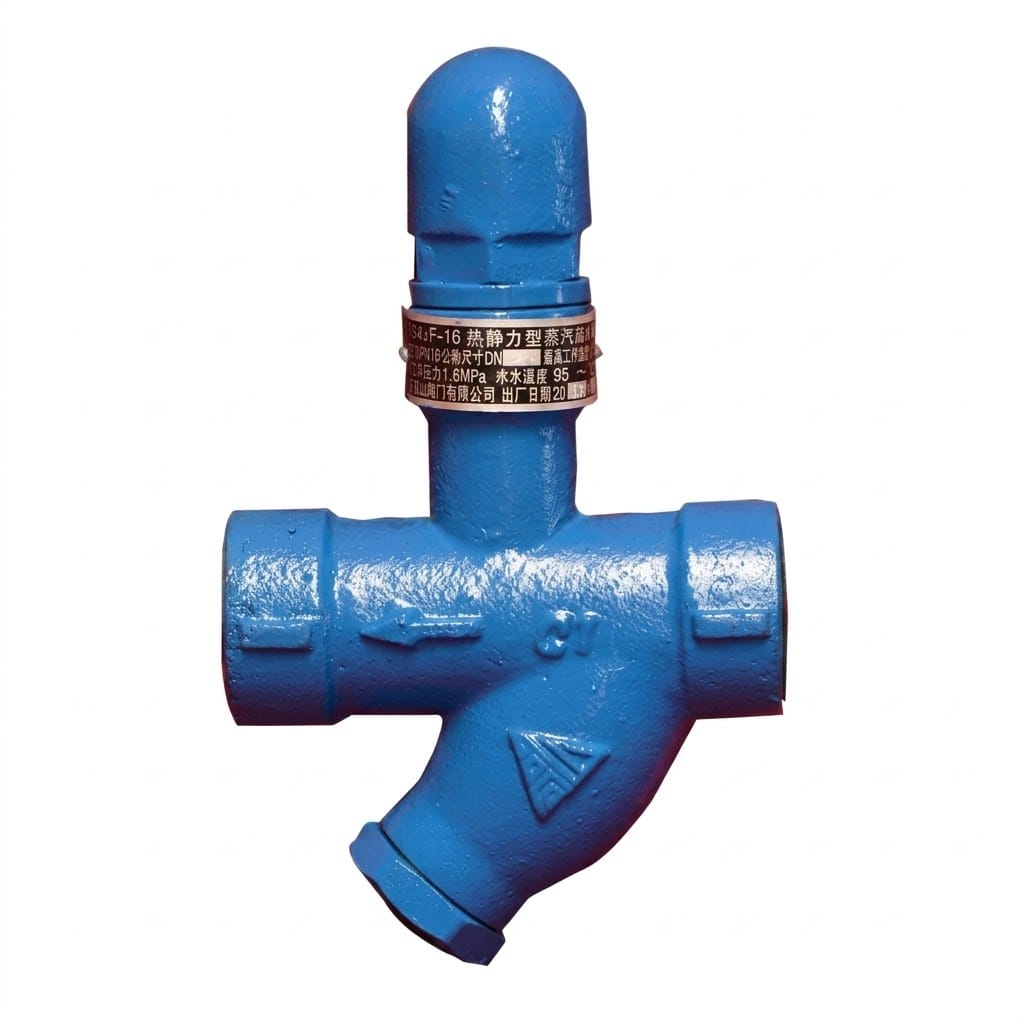
The S44F-16 / S14F-16 thermostatic steam trap — also referred to as a bellows steam trap or liquid expansion steam trap — is an energy-saving steam trap engineered by Gaoshan Valve for industrial steam heating and condensate recovery applications across the petrochemical, metallurgical, rubber, pharmaceutical, and food processing industries. Unlike conventional mechanical steam traps, this bellows-operated thermostatic steam trap uses a temperature-sensitive liquid expansion element sealed inside a stainless steel bellows to sense the temperature difference between live steam and sub-cooled condensate. During cold start-up, the trap opens wide to rapidly discharge large volumes of cold condensate and air — preventing water hammer and accelerating system warm-up. As the condensate temperature rises toward the steam saturation point, the thermostatic element expands to progressively close the valve, maintaining an optimal subcooled condensate discharge temperature. Two selectable discharge temperature bands (90–95°C for Type 01, 95–135°C for Type 02) allow the trap to be matched to specific process requirements — recovering valuable sensible heat from hot condensate while ensuring no live steam is lost. The result is a thermostatic steam trap with large drainage capacity, ultra-low steam loss (≤0.5% no-load leakage), silent operation, water hammer resistance, and built-in freeze protection — all in a compact, maintenance-friendly package. As a steam trap manufacturer with 50 years of experience, Gaoshan Valve delivers factory-direct pricing and CE/API/ISO 9001 certified quality.
Key Advantages of the S44F/S14F Thermostatic Steam Trap
Dual Discharge Temperature Bands for Heat Recovery
Two factory-set thermostatic element options: Type 01 closes at 90–95°C for maximum condensate heat recovery, and Type 02 closes at 95–135°C for applications requiring hotter condensate return. Select the right band to optimize energy savings for your steam system.
Ultra-Low Steam Loss — ≤0.5%
The precision thermostatic element responds to temperature, not pressure differential, ensuring the trap closes tightly before live steam reaches the orifice. Rated no-load air leakage ≤0.5% — among the lowest in the industry — translating directly to fuel savings.
High Back-Pressure Tolerance — ≥80%
Operates reliably with back pressure up to 80% of inlet pressure, making it ideal for condensate recovery systems with elevated return headers, flash vessels, or closed-loop condensate return networks.
Silent, Water-Hammer-Free Operation
The thermostatic element provides smooth, modulating throttling action — no rapid cycling, no snapping discs, no audible discharge noise. The trap also resists water hammer damage thanks to its robust bellows-sealed design.
Rapid Cold-Start Air & Condensate Discharge
During system start-up, the cold thermostatic element is fully contracted, providing maximum orifice opening to quickly purge cold condensate and air. This eliminates water pockets, prevents corrosion, and brings the steam system to operating temperature faster.
Freeze Protection — Drains Completely When Cold
The bellows steam trap is designed to remain open when cold, ensuring condensate drains completely from the body on system shutdown. This provides built-in freeze protection for outdoor or unheated installations — a common failure mode of inverted bucket and float traps that retain standing water.
Technical Specifications
| Parameter | Value |
|---|---|
| Nominal Pressure | PN16 |
| Maximum Working Pressure | 1.6 MPa |
| Minimum Working Pressure | 0.05 MPa |
| Maximum Allowable Temperature | 203°C |
| Maximum Back-Pressure Ratio | ≥80% |
| No-Load Air Leakage Rate | ≤0.5% |
| Discharge Temperature — Type 01 | 90°C – 95°C (closes as temp rises) |
| Discharge Temperature — Type 02 | 95°C – 135°C (closes as temp rises) |
| Nominal Diameter | DN15 – DN50 |
| Connection Type | Female Threaded (NPT/BSPT) or Flanged (RF) |
| Suitable Medium | Steam, condensate, air |
| Actuation Type | Thermostatic (liquid-expansion bellows element) |
Main Parts & Materials
| Part Name | Material |
|---|---|
| Body | WCB Cast Steel |
| Bonnet / Cover | WCB Cast Steel |
| Seat | 2Cr13 Stainless Steel (hardened) |
| Valve Disc | 2Cr13 Stainless Steel (hardened) |
| Thermostatic Element (Bellows) | Stainless Steel Bellows with Special Thermo-Sensitive Liquid |
| Filter Screen | 304 Stainless Steel Mesh |
| Gasket | Graphite + Stainless Steel Spiral Wound |
| Bolts / Nuts | Carbon Steel (zinc-plated or black oxide) |
Model Selection
| Model | Connection | Body Material | Pressure Class | Temp. Limit |
|---|---|---|---|---|
| S44F-16 | Flanged (RF) | WCB Cast Steel | PN16 | ≤203°C |
| S14F-16 | Female Threaded | WCB Cast Steel | PN16 | ≤203°C |
Temperature Band Selection: Append “-01” to the model for 90–95°C discharge temperature (maximum heat recovery), or “-02” for 95–135°C discharge temperature (hotter condensate return). Example: S44F-16-01 or S14F-16-02.
How a Bellows Thermostatic Steam Trap Works — Liquid Expansion Principle
The S44F/S14F thermostatic steam trap operates on the principle of liquid thermal expansion. Inside the stainless steel bellows element is a precisely calibrated thermo-sensitive liquid. When cold condensate or air surrounds the element (temperature below the set closing point), the liquid contracts, causing the bellows to compress and the valve disc to lift off the seat — opening a wide flow path for rapid discharge. As hot condensate approaches the steam saturation temperature, the liquid inside the bellows expands, pushing the bellows outward and driving the valve disc toward the seat. When the condensate temperature reaches the upper limit of the selected band (95°C for Type 01, or 135°C for Type 02), the valve closes tightly, preventing live steam from escaping. Because the element responds to temperature rather than pressure differential, the trap self-compensates for wide variations in system pressure and load — opening fully at low pressures and modulating smoothly at high pressures. This temperature-based actuation also means the trap automatically purges cold condensate and air at start-up without any manual intervention.
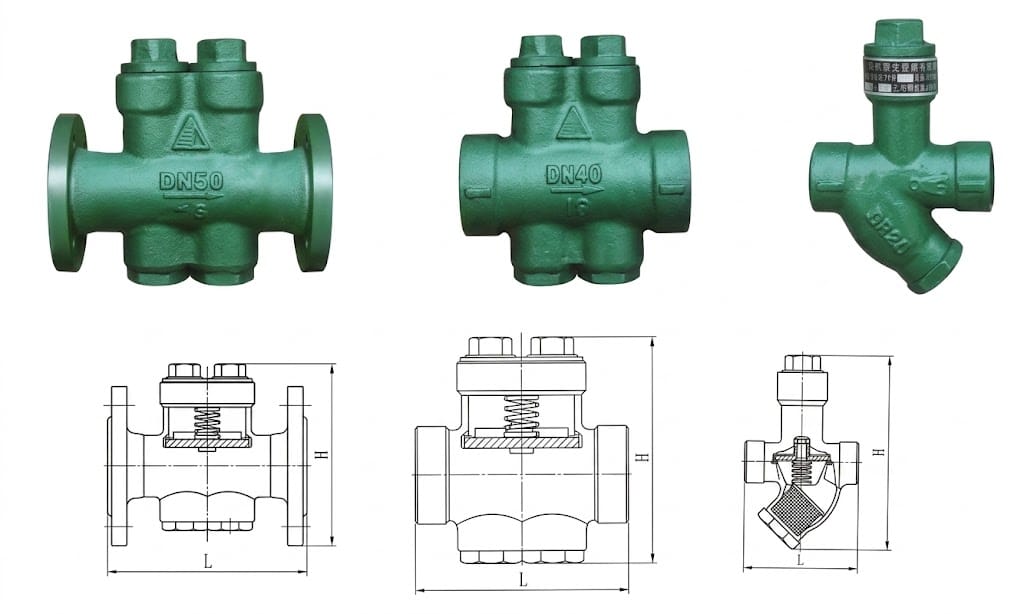
S44F-16 / S14F-16 Thermostatic Steam Trap — Structure & Working Principle Diagram
Dimensions (mm)
| DN | Inch | Connection | L (Face-to-Face) | H (Overall Height) |
|---|---|---|---|---|
| 15 | 1/2″ | Threaded | 90 | 155 |
| 15 | 1/2″ | Flanged | 155 | 155 |
| 20 | 3/4″ | Threaded | 100 | 155 |
| 20 | 3/4″ | Flanged | 190 | 155 |
| 25 | 1″ | Threaded | 120 | 159 |
| 25 | 1″ | Flanged | 200 | 159 |
| 32 | 1-1/4″ | Threaded | 130 | 169 |
| 32 | 1-1/4″ | Flanged | 230 | 169 |
| 40 | 1-1/2″ | Threaded | 140 | 152 |
| 40 | 1-1/2″ | Flanged | 230 | 167 |
| 50 | 2″ | Threaded | 160 | 152 |
| 50 | 2″ | Flanged | 230 | 175 |
*Note: Threaded connections: NPT or BSPT per order. Flange dimensions per GB/T 9113 / JB/T 79 (PN16 RF). The S44F-16 is supplied with flanged ends; the S14F-16 is supplied with female threaded ends. H dimensions may vary slightly for different temperature band (-01 / -02) elements.
Thermostatic Steam Trap Installation & Maintenance Guidelines
- Install with the body in a horizontal pipeline and the thermostatic element (bonnet) facing upward for optimal condensate drainage and temperature sensing
- Mount a Y-type strainer immediately upstream of the trap to protect the thermostatic element and seat from scale, rust, and pipe debris
- Provide a blow-down valve on the strainer for periodic cleaning without removing the trap
- Install an isolation valve (gate or ball valve) on both the inlet and outlet sides to permit trap removal for inspection or replacement
- Install a test valve on the trap outlet to allow periodic live testing of trap performance by observing discharge temperature and pattern
- Ensure the downstream condensate return line is adequately sized and vented to prevent back-pressure from exceeding 80% of inlet pressure
- For outdoor installations in freezing climates, insulate the trap body and downstream piping to prevent condensate from freezing in the discharge line
- When replacing an existing trap, verify the pressure rating, connection size, and discharge temperature band match the original specification — do not substitute a different temperature band without engineering review
- After installation, verify the trap discharges cold condensate during warm-up, then quiets as steam reaches the trap. A continuously blowing trap indicates an incorrect temperature band or a failed element
Industrial Applications — Where Thermostatic Steam Traps Excel
Chemical Processing Plants
Metallurgy & Steel Making
Rubber & Tire Manufacturing
Pharmaceutical Production
Food & Beverage Processing
Textile Dyeing & Finishing
Pulp & Paper Mills
HVAC Steam Heating
Hospital Sterilization
District Heating Networks
Power Generation
Quality Standards & Certifications
- Design & Manufacture: GB/T 12247 (Steam Trap)
- Face-to-Face Dimensions: GB/T 12250
- Flange Ends: GB/T 9113 / JB/T 79
- Threaded Ends: GB/T 7306 / ISO 7-1
- Test & Inspection: GB/T 12251 (Steam Trap — Test Methods)
- ISO 9001 Quality Management System Certified
- CE Certified
- API Licensed
- 100% cold hydrostatic shell test at 2.4 MPa before shipment
- 100% air seat leakage test to verify ≤0.5% leakage rate
- 100% thermostatic element calibration test to verify opening and closing temperatures
Packaging & Shipping
Each S44F/S14F thermostatic steam trap is individually packed with protective threaded caps or flange covers, sealed in a poly bag with desiccant, and secured in a corrugated carton or plywood case for export shipment. The thermostatic element bonnet is protected with foam padding to prevent mechanical shock. All shipments include a packing list, material certificate, hydrostatic test report, and thermostatic element calibration certificate. We support FOB, CIF, DAP, and other Incoterms.
After-Sales Service
- 18-month warranty from date of delivery under normal operating conditions
- Technical support for trap sizing, selection, and system troubleshooting
- Spare thermostatic element cartridges available for field replacement without removing the trap body
- Spare seats, discs, gaskets, and filter screens available for maintenance
- On-site inspection and trap survey service available upon request
Steam Trap Selection Guide — Which Type Do You Need?
Answer these 3 questions and our engineers will recommend the right model for your application.
1What is your steam pressure?
Low pressure (≤1.6 MPa) systems can use all three series. High pressure (2.5–4.0 MPa) or high temperature (>250°C) applications typically require CS11H / CS41H free float ball traps.
2What equipment are you draining?
For steam mains and tracing lines, choose BS19H / BS49H. For heat exchangers and condensate recovery, choose CS11H / CS41H. For energy recovery and temperature-critical processes, choose S44F / S14F.
3What is your priority?
Need minimum maintenance? → BS19H/BS49H. Need maximum heat transfer? → CS11H/CS41H. Need lowest steam loss and freeze protection? → S44F/S14F.
Compare Gaoshan Steam Trap Series
Not sure which type fits your application? Compare all three Gaoshan steam trap series side by side to find the best match.
| Feature | BS19H / BS49H Thermodynamic (Disc) |
CS11H / CS41H Free Float Ball |
S44F / S14F Thermostatic (Bellows) |
|---|---|---|---|
| Operating Principle | Thermodynamic disc opens/closes by flash steam pressure differential; single moving part | Free-floating ball rises/falls with condensate level; continuous drainage via float buoyancy | Liquid-expansion bellows responds to condensate temperature; modulates based on subcooling |
| Pressure Rating | PN16 – PN25 | PN16 – PN40 | PN16 |
| Max Temperature | 250°C | 425°C | 203°C |
| Discharge Type | Intermittent (cyclic on/off) | Continuous | Modulated (proportional to temperature) |
| Steam Loss | Low — disc seals tight after each cycle; minor bleed during operation | Very Low — water seal prevents steam leakage; near-zero in normal operation | Very Low — closes before steam reaches orifice; rated ≤0.5% no-load leakage |
| Back-Pressure Tolerance | Moderate — back pressure affects disc cycling frequency; typically ≤50% of inlet | High — float mechanism tolerates significant back pressure; suitable for condensate return | High — ≥80% of inlet pressure; well-suited for closed-loop condensate recovery |
| Freeze Protection | Limited — may retain condensate when closed; requires insulation or tracing in cold climates | Limited — body retains water; requires insulation and/or steam tracing for outdoor use | Built-in — drains completely when cold; element stays open below set temperature |
| Typical Applications | Steam main drip legs, steam tracing lines, outdoor piping where simplicity and durability are key | Heat exchangers, air heater coils, condensate recovery systems, high-pressure/high-temp processes | Low-to-medium pressure heat recovery, freeze-prone areas, HVAC heating, processes needing controlled subcooling |
| DN Range | DN15 – DN25 | DN15 – DN50 | DN15 – DN50 |
| Maintenance | Low — only one moving part (disc); no internal linkage or mechanism | Moderate — float and seat require periodic inspection; internal mechanism has multiple components | Low — bellows element is field-replaceable cartridge; no internal linkage or pivot points |
Case Study: Energy-Saving Steam Trap Retrofit — Chemical Plant Saves 18% Fuel
How S44F thermostatic steam traps reduced fuel costs and eliminated water hammer
From Leaking Traps to Tight Shut-Off
A chemical processing facility in Southeast Asia was experiencing high fuel costs due to leaking steam traps and waterlogging in heat exchangers. Their existing traps were failing to seal tight, causing live steam loss and reduced heat transfer efficiency.
After switching to Gaoshan S44F-16 thermostatic steam traps with Type 01 (90–95°C) temperature bands, the plant achieved:
- Tighter shut-off with ≤0.5% steam loss rate
- Better condensate drainage with dual temperature settings
- Reduced water hammer and improved heat exchanger performance
- Freeze protection during seasonal shutdowns
Estimated Fuel Savings
Steam Loss Rate
Warranty Period
Frequently Asked Questions About Thermostatic Steam Traps
What is the difference between Type 01 and Type 02 temperature bands?
Type 01 closes at 90–95°C, which maximizes condensate heat recovery — ideal for energy-conscious applications where you want to extract as much sensible heat as possible before discharge. Type 02 closes at 95–135°C, which keeps condensate hotter — better for applications that need hotter condensate return to a central recovery system. Choose based on your plant’s energy balance requirements.
How does the S44F/S14F compare to a float trap for heat exchanger duty?
Float traps (CS11H/CS41H) provide continuous discharge and are excellent for heat exchangers at higher pressures. However, the S44F/S14F thermostatic trap offers an advantage in two areas: (1) significantly lower steam loss (≤0.5% vs. potential live steam leakage if the float mechanism wears), and (2) built-in freeze protection since the trap drains completely when cold. For PN16 heat exchanger applications where steam loss is a key concern, the S44F is often the better choice.
Can the S44F/S14F be used outdoors in cold climates?
Yes. The thermostatic element remains open when cold, so the trap body drains completely on shutdown — no standing water to freeze and crack the body. This is a key advantage over bucket and float traps, which retain water and are vulnerable to freeze damage. We still recommend insulating the trap body and downstream piping for optimal energy efficiency.
How often does the thermostatic element need replacement?
Under normal operating conditions with clean steam (proper upstream filtration), the stainless steel bellows element typically lasts 3–5 years or more. The element is field-replaceable without removing the trap body from the pipeline. We recommend annual inspection and testing as part of a routine steam trap survey program.
Do you provide material certificates and test reports?
Yes. Each shipment includes a material certificate, hydrostatic shell test report (2.4 MPa), air seat leakage test report (verifying ≤0.5%), and thermostatic element calibration certificate. CE, API, and ISO 9001 certifications are available upon request. Third-party inspection (SGS, BV, TÜV) is supported.
Get a Quote — S44F / S14F Thermostatic Steam Trap | Factory Direct Pricing
As a steam trap manufacturer with 50 years of experience, Gaoshan Valve offers factory-direct pricing on the complete S44F/S14F thermostatic steam trap series. Need help with steam trap selection, sizing, or selecting the right discharge temperature band? Contact our engineers today for competitive pricing, technical specifications, and energy-saving optimization guidance.