
When the Power Goes Out: Why Mechanical Check Valves Still Belong in Every Pump Room
A quiet design trend has been gaining traction in modern HVAC and district-heating pump rooms: removing the check valve from the pump discharge line and replacing it with a motorized valve electrically interlocked to the pump — opening as the pump starts, closing as it stops.
The logic is straightforward. A fully open motorized valve creates less resistance than a traditional check valve, reducing the head the pump must work against and trimming a bit off the energy bill. On paper, in a “high-efficiency machine room,” that looks like a clean win.
It is a legitimate engineering idea — but it only works as well as its weakest link. And that weak link is electricity.
1. The Question Every Design Should Answer Before Removing a Check Valve
A motorized valve only does what its control signal tells it to do, and it can only move if its actuator has power. In a scheduled shutdown — an operator pressing “stop,” or a building automation system cycling a pump off — everything works exactly as intended. Control power is present, the interlock logic fires, the valve closes on cue.
The scenario that really matters is different: a sudden, unplanned loss of power to the entire pump room.
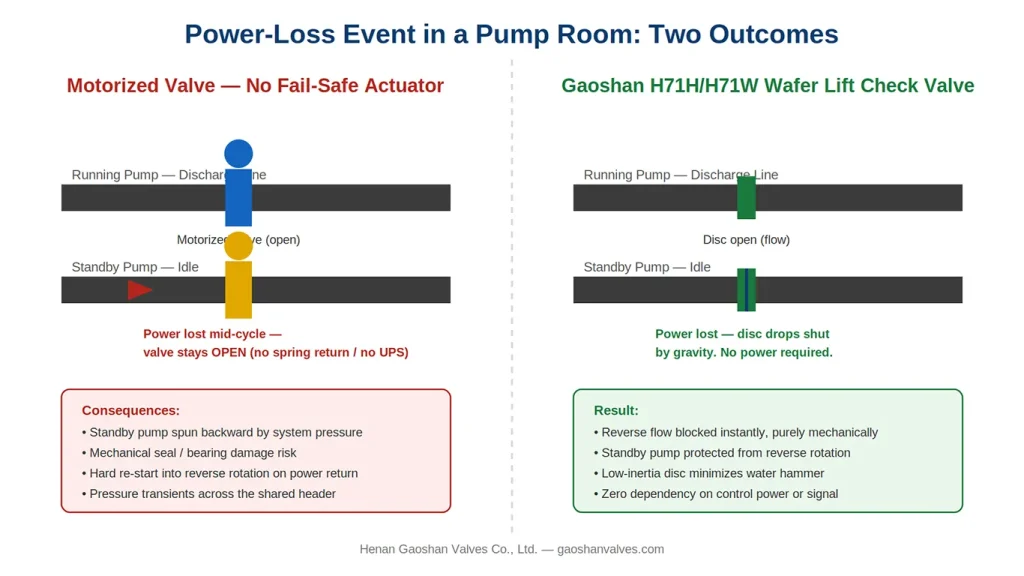
In that moment, the controller and the actuator typically share the same power source. There is no electricity to execute a “close” command, no matter how well the interlock logic was written. Unless the actuator has its own independent means of closure — a spring-return mechanism using stored mechanical energy, or a battery/UPS module that powers a final close cycle — the valve stays wherever it was when the lights went out. And that position, more often than not, is fully open.
2. What an Open Valve Costs You During a Blackout
When a discharge valve fails to close during a power outage in a multi-pump header system, the consequences are far from cosmetic:
| Risk | Impact |
| Reverse pump rotation | With nothing blocking the discharge line, system pressure forces the idle standby pump backward — spinning the impeller in reverse at high speed |
| Mechanical seal & bearing damage | Reverse rotation imposes non-design-direction loads on seal faces and bearings |
| Hard re-start on power return | If power returns while the pump is still spinning backward, the motor must overcome reverse inertia — a far harsher event than a normal start-up |
| Water hammer | Uncontrolled backflow and sudden pressure redistribution across the header is itself a source of pressure transients, at the very moment the system is already stressed by the outage |
| System-wide hydraulic imbalance | In systems with multiple pumps sharing one header, a single unprotected line can destabilize the entire loop |
None of this appears in a resistance calculation or an energy audit. It appears during the one event every mechanical room is ultimately built to survive.
3. The Case for a Purely Mechanical Fail-Safe
This is exactly why the check valve has never truly disappeared from serious pump protection design, even as “efficient machine room” concepts push to minimize every other source of resistance.
A well-designed mechanical check valve needs no control signal, no actuator, no power supply, and no interlock logic to do its job. It closes because physics — gravity and reverse flow — tells it to. Every single time. Including the one time the entire building loses power at once.
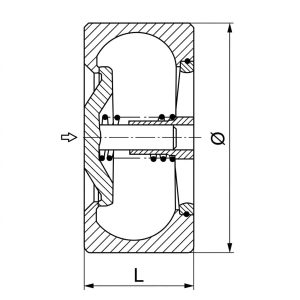
That is the specific gap the Gaoshan H71H/H71W Wafer Lift Check Valve is built to close.
Key Features of the H71H/H71W
| Feature | Technical Detail |
| Rapid closure, low water hammer | Lightweight, low-inertia disc lifts open under forward flow and drops shut the instant flow stops or reverses — closing fast enough to limit pressure spikes on the pump discharge line |
| Zero power dependency | All-metal, spring-free, actuator-free design. There is nothing to lose power to |
| Ultra-compact wafer body | Installs directly between two existing pipe flanges using the same bolt set — adds pump protection without consuming face-to-face length in an already crowded plant room |
| Vertical or horizontal installation | The guided disc mechanism performs reliably in either orientation, simplifying layout and reducing the number of valve types a project must stock |
| Material options for the entire plant | 2Cr13 for general water, steam, and oil service up to 425°C; 1Cr18Ni9Ti (304) for nitric acid duty; 1Cr18Ni12Mo2Ti (316) for acetic acid and other severe corrosive media |
| Near-zero maintenance | No springs, bearings, or external actuators to service; periodic inspection of the disc and seat is normally all that is required |
Specifications at a Glance
| Parameter | Range / Standard |
| Pressure ratings | PN16 / PN25 / PN40 |
| Size range | DN15 – DN150 |
| Design standard | GB/T 12236 |
| Face-to-face dimensions | GB/T 12221 |
| Flange standards | GB/T 9113 / JB/T 79 / HG/T 20592 |
| International standards (on request) | EN 13709 / EN 558 / API 594 |
4. Practical Recommendation: Layered Protection, Not Either/Or
None of this means motorized valves are the wrong choice. Interlocked motorized valves genuinely reduce system resistance and give operators better diagnostics and control during normal operation. The point is what happens outside normal operation.
For any pump room where a motorized valve is replacing the discharge check valve, two questions belong in the technical specification before the design is finalized:
- Does the actuator have a genuine fail-safe close function? Spring-return or UPS-backed — not just a software interlock.
- Has that fail-safe actually been tested under a real power cut? Not just simulated with a control signal.
Where the answer is uncertain, or where pump head, standby-pump count, or reliability requirements are high, the safer architecture keeps both devices in the line: the motorized valve for everyday efficiency and control, and a fast-closing mechanical check valve like the H71H/H71W as the last line of defense — one that works with or without electricity.
5. About Gaoshan Valve
Henan Gaoshan Valves Co., Ltd. has been manufacturing industrial valves since 1975 — over 50 years of expertise serving projects across more than 20 countries. We hold CE, API 6D, and ISO 9001/14001/45001 certifications, and are an approved supplier to Sinopec and CNPC.
For dimension sheets, CAD drawings, material certifications, or assistance selecting the right check valve for a specific pump-protection application, contact our technical team.